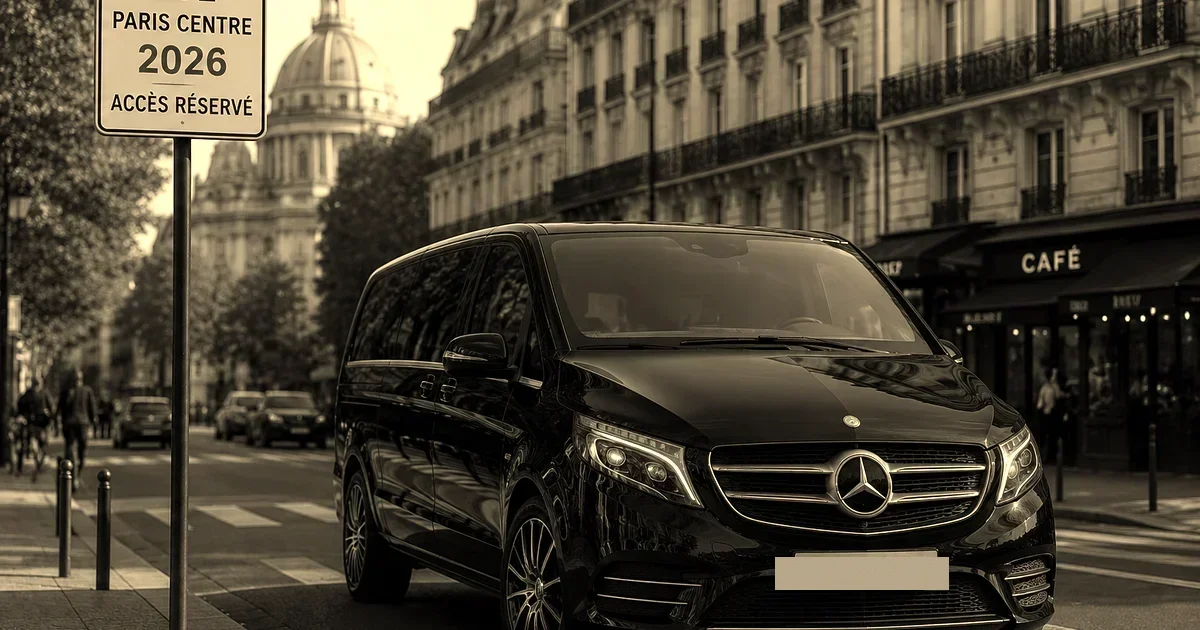
The acronym that defines access to Europe’s historic centres is Italian. Zona a Traffico Limitato, the ZTL, predates by two decades the Paris experiment that French operators discuss as a novelty. Bologna ran the first modern ZTL in 1989. Rome, Florence, Milan, Pisa and Siena followed through the 1990s. When Paris launched its ZTL Paris Centre on 5 November 2024, it imported a governance model that Italian municipalities had already stress tested across a generation of automatic-plate enforcement, permit registries and resident derogations. A premium chauffeur operator running cross-border routes between Milan, Geneva, Paris and London is therefore navigating not one restriction logic but four distinct legal families, each with its own penalty architecture and its own treatment of the professional vehicle.
The operational stakes are concrete. A vehicle that crosses the wrong threshold in Rome can collect more than one fine in a single hour, because each camera generates an independent infraction. A vehicle in London that was exempt from the Congestion Charge in 2025 is now liable, because the electric-vehicle discount changed on 25 December 2025. A diesel berline that entered Milan without friction in 2023 may be banned outright by Area B emission-class rules in 2026. For an operator whose clients pay a premium precisely to avoid friction at the door of a five-star hotel, knowing exactly which zone applies, what it costs and whether the professional derogation holds is no longer background knowledge. It is the product.
Two restriction families that operators routinely confuse
European access restrictions split into two mechanisms that share cameras but answer different questions. The first asks where a vehicle may drive. The Italian ZTL, the Paris ZTL Paris Centre and most pedestrian-zone perimeters belong here. They restrict access by status and purpose, not by engine. A resident, a taxi, a hire car with driver or a registered hotel guest may enter; through traffic may not. The vehicle’s emission class is irrelevant to the ZTL itself.
The second mechanism asks what a vehicle emits. The London ULEZ, the German Umweltzone, the Paris ZFE and Milan Area B sit here. They restrict access by Euro standard, sticker or charge, and they do not care about the trip’s purpose. A Euro 2 diesel is barred whether it carries a tourist or a head of state. Milan Area C complicates the picture by combining both logics in one perimeter: it is a congestion charge layered over a low-emission filter, inside the historic-centre ZTL. An operator who treats these as interchangeable will plan the wrong compliance for the wrong city. The penalty for an emission breach is paid even when the vehicle had every right to be there as a professional, and the professional derogation from a ZTL offers no shelter against an emission charge.
Italy: the ZTL homeland and the Area C and Area B overlay
Italy operates more limited-traffic and low-emission perimeters than any other European country, with hundreds of municipal ZTL schemes recorded across the peninsula. Enforcement is overwhelmingly camera based. A ZTL fine in Italy runs from roughly 80 to 335 euros depending on the municipality, and the structural risk for a non-resident driver is multiplication: each camera passed generates a separate fine, so a single confused loop through Rome’s centre can produce several penalties on the same morning. Italian authorities pursue foreign-plated vehicles through cross-border recovery, often months after the trip.
Rome layers a low-emission scheme over its historic ZTL. From 1 November 2025, the city’s Green Zone bars diesel engines up to Euro 5 and petrol up to Euro 2, enforced annually from 1 November to 31 March on weekdays between 08:30 and 18:30. The central ZTL operates on its own timetable, with restricted hours that vary by sub-zone and tighten in the evening for the Tridente and Trastevere districts. A premium operator collecting a client from a hotel inside the Rome ZTL relies on the accommodation registering the vehicle plate with the comune, the same mechanism Italian hotels use for guests, which converts an otherwise prohibited entry into an authorised arrival for drop-off and pick-up.
Florence runs one of the strictest perimeters in the country. Its ZTL divides into sectors A, B and O, with sector A off limits at all hours without a permit and camera coverage that catches the briefest incursion. Florence is also where the structural tension between taxis and hire cars with driver, the noleggio con conducente or NCC, surfaced most visibly in 2025, with taxi strikes in July and a string of implementing decrees on NCC activity suspended by the administrative courts through late 2025. The regulatory uncertainty around NCC access does not change the ZTL rules, but it shapes how a chauffeur firm documents its right to enter, since enforcement officers scrutinise NCC status more closely in Tuscany than in most European jurisdictions.
Milan is the instructive case because it stacks three systems. Area C is the historic-centre congestion charge, an 8.2 square kilometre perimeter inside the old ZTL, active Monday to Friday from 07:30 to 19:30, with a standard day ticket at 7.50 euros. Area B is the city-wide low-emission zone covering almost the entire urban area, which progressively bars older engines. From 1 October 2025 Milan extended the ban to Euro 3 petrol vehicles, with further restrictions on two-stroke motorcycles and older diesels deferred to 1 October 2026.
A chauffeur arriving at a Milan hotel inside Area C therefore needs a vehicle that clears the Area B emission filter, then accounts for the Area C charge, then respects the underlying ZTL access window. The same trip touches all three. Operators planning fleet renewal against these tightening Euro thresholds face the same calculus documented in our reading of roadworthiness and Euro 7 obligations for chauffeur fleets, where the emission class of the vehicle becomes a city-access question rather than a purely technical one.
London: the Congestion Charge, ULEZ and the end of the EV exemption
London separates its two charges cleanly, which makes it easier to plan and more expensive to misread. The Congestion Charge applies to the central zone on weekdays from 07:00 to 18:00 and on weekends from 12:00 to 18:00. From 2 January 2026 the daily charge rose from 15 to 18 pounds, with Transport for London signalling annual increases tied to public-transport fare inflation. The Ultra Low Emission Zone, ULEZ, covers the whole of Greater London and runs 24 hours a day, charging non-compliant vehicles 12.50 pounds per day. Petrol cars meeting Euro 4 and diesel cars meeting Euro 6 are compliant; older vehicles pay.
The change that reorganised London fleet economics in late 2025 is the end of the Cleaner Vehicle Discount. Until 24 December 2025, a fully electric vehicle paid neither charge. From 25 December 2025, electric cars became liable for the Congestion Charge. Transport for London softened the shift with a registered discount: an electric car on Auto Pay pays 13.50 pounds against the 18 pound standard, a 25 percent reduction that holds until 4 March 2030 before falling to 12.5 percent. Electric vans and heavy goods vehicles receive a 50 percent discount. The ULEZ exemption for fully electric cars remains in place, so an electric berline still avoids the 12.50 pound emission charge while now paying the congestion fee.
For a premium operator in London, the December 2025 change converts a free electric fleet into a charged one, at 13.50 pounds per vehicle per central-zone day for those registered on Auto Pay. A firm running eight cars on daily City and West End assignments absorbs roughly 108 pounds a day, or above 28,000 pounds across a working year, a line that did not exist in 2024. The penalty for non-payment is the sharper risk: a missed Congestion Charge now draws a penalty charge notice of 180 pounds, reduced to 90 pounds if settled within 14 days. Across a busy fleet, a handful of missed registrations a month dwarfs the charge itself, which is why London operators run automated plate-and-payment systems rather than relying on driver discipline.
Paris: ZTL Paris Centre and the ZFE running in parallel
Paris imported the ZTL model and runs it alongside its low-emission zone, reproducing the Italian two-layer structure on French soil. The ZTL Paris Centre, in force since 5 November 2024, covers the first four arrondissements and bars through traffic while allowing destination traffic. After a pedagogical phase extended by the Prefecture de Police into 2026, enforcement moves to automatic plate recognition, with the breach treated as a fourth-class contravention: 135 euros at the standard rate, 90 euros if paid early, 375 euros if escalated. Taxis and hire cars with driver hold a derogation by right, with no prior authorisation, though the driver must be able to corroborate professional status if challenged.
The parallel system is the Greater Paris ZFE, the emission zone that filters vehicles by Crit’Air sticker rather than by purpose. A chauffeur entering central Paris in 2026 satisfies the ZTL through professional status and the ZFE through the vehicle’s Crit’Air class. The two are independent: the ZTL derogation does not exempt a non-compliant engine from the ZFE, and a clean engine does not authorise through traffic in the ZTL. This is the same architecture an operator meets in Milan, where Area C and Area B answer different questions in the same square kilometre. The detailed operator reading of the Paris perimeter, its enforcement calendar and the value of the derogation as a commercial argument sits in our French-language analysis of the ZTL Paris Centre and its impact on transfers.
Germany: the Umweltzone and a purely emission-based logic
Germany took the opposite path from Italy. It has no widespread purpose-based ZTL equivalent and instead built its access policy entirely on emissions through the Umweltzone, the environmental zone. Access depends on the Umweltplakette, the windscreen sticker that classifies a vehicle by Euro standard. Since 2025, only the green sticker permits entry to German environmental zones, with red and yellow stickers no longer issued or accepted, the sole exception being Neu-Ulm. The green badge requires at least Euro 4 for diesel and Euro 1 for petrol, a threshold any modern premium berline clears comfortably.
More than 50 German cities operate an Umweltzone, including Berlin, Munich, Stuttgart, Frankfurt and Cologne. The sticker carries lifetime validity and costs between 6 and 20 euros. The fine for driving into a zone without the correct badge is 100 euros, applied identically to German and foreign-registered vehicles. A handful of cities, Stuttgart, Munich and Darmstadt among them, add targeted diesel driving bans on specific corridors that go beyond the green-sticker baseline. For a premium operator, German access is the simplest of the four families: equip every vehicle with a green Umweltplakette, verify the city-specific diesel corridors, and the access question is closed. There is no purpose-based perimeter to negotiate and no per-camera multiplication risk.
The five systems side by side and what they cost the fleet
The matrix below maps the principal restriction regimes against the variables that determine operator exposure: the restriction type, the penalty level, and whether a professional vehicle holds a derogation or must comply on the same terms as any other. The asymmetry across the rows is the operative point. Italy and Paris grant the professional vehicle a purpose-based pass; London and Germany do not, because their charges are about emissions and congestion, not status.
| City / zone | Restriction type | Penalty (2026) | Professional derogation |
|---|---|---|---|
| Rome ZTL + Green Zone | Purpose (ZTL) + emission (Euro 5 diesel ban) | ~80–335 euros per camera | ZTL: taxi/NCC and registered hotel plate; emission: none |
| Florence ZTL (A/B/O) | Purpose, sector A barred at all hours | ~80–335 euros per camera | NCC permit and plate registration, scrutinised closely |
| Milan Area C | Congestion charge inside historic ZTL | 7.50 euros/day; fine ~80+ euros | Charge applies; some NCC and service exemptions |
| Milan Area B | Emission (Euro class, tightening to 2026) | Camera fine for barred engines | None: engine-class based |
| London Congestion Charge | Congestion (central zone, timed) | 18 pounds/day; 180 pound PCN (90 if early) | EV 25% discount on Auto Pay; no purpose exemption |
| London ULEZ | Emission (Greater London, 24/7) | 12.50 pounds/day non-compliant | Full BEV exempt; no purpose exemption |
| Paris ZTL Paris Centre | Purpose (no through traffic) | 135 euros (90 early, 375 escalated) | Taxi and VTC by right, status must be provable |
| Paris ZFE | Emission (Crit’Air sticker) | Crit’Air contravention | None: sticker-class based |
| German Umweltzone | Emission (green Umweltplakette) | 100 euros without correct badge | None: green sticker mandatory for all |
Read across the table and a planning rule emerges. Where the restriction is purpose based, the operator’s asset is documentation: the NCC permit, the VTC card, the hotel plate registration that converts a barred street into an authorised arrival. Where the restriction is emission based, the operator’s asset is the vehicle itself: a green Umweltplakette, a compliant Crit’Air class, a battery-electric drivetrain that clears ULEZ. A fleet built only for one logic fails the other. A diesel berline with every professional credential in order still pays the London ULEZ and is barred from Milan Area B. An electric car with no purpose documentation still cannot run through traffic in the Rome or Paris ZTL.
How a premium operator plans access in practice
Sophisticated operators run access as a layer of the journey plan, not as a driver’s improvisation. The first discipline is fleet specification against the strictest emission filter on the route. A vehicle that will see London, Milan and central Paris in a given month is specified to clear ULEZ, Area B and the ZFE simultaneously, which in practice points the procurement decision toward battery-electric or the newest compliant diesel and hybrid configurations. The emission filter, not the comfort specification, sets the floor. This is where access policy and the broader electrification calendar intersect, a convergence detailed in our cross-jurisdiction reading of EU fleet electrification mandates across France, the UK and Germany, where the same vehicle decision answers both the mandate and the city-access question at once.
The second discipline is documentation hygiene for purpose-based zones. In Italy and Paris, the professional derogation is only as good as the proof carried on board. An NCC contract, the registration with the relevant register, and the ability to produce the hotel plate registration within seconds are what convert a camera-detected entry into a defensible one. Italian municipalities and the Paris Prefecture both enforce through automatic plate recognition, which removes the contradictory exchange at the roadside, so the contest moves to the appeal stage and is won or lost on paperwork prepared in advance.
The third discipline is payment automation for charge-based zones. London is the model. The 180 pound penalty for a missed Congestion Charge is more than ten times the charge itself, so operators run fleet Auto Pay accounts that settle the charge automatically on any day a vehicle enters the zone, and apply the registered electric-vehicle discount without manual intervention. Milan Area C follows the same logic with its day ticket. The cost discipline is not the charge, which is predictable and budgetable, but the penalty, which is avoidable entirely through automation.
The fourth discipline is timetable awareness, because most purpose-based zones layer temporary closures on top of the permanent perimeter. Paris adds the Sunday and public-holiday Paris Respire closures and event-driven restrictions for state ceremonies and major sporting fixtures. Rome and Florence shift their ZTL evening windows seasonally. Milan suspends Area C on specific calendar days.
A 13:00 Sunday transfer to a hotel inside a zone that has pedestrianised for the afternoon generates 30 to 50 minutes of avoidable detour and a client who notices. The operator who integrates the closure calendar into the routing at the booking stage, rather than discovering it at the threshold, delivers the seriousness a premium client is paying for. This rail-and-road coordination matters more as standard transfers migrate to rail and only the high-value door-to-door journeys stay on the road, a shift we examine in our analysis of airport rail links reshaping European premium transfers.
The direction of travel across the decade
Every trend in the data points the same way. Rome tightened its Green Zone in November 2025. Milan extended Area B in October 2025 with a further phase in October 2026. London ended its electric-vehicle Congestion Charge exemption in December 2025 and has scheduled annual increases. Paris confirmed ZTL enforcement for 2026 and signals an extension of the perimeter to further arrondissements before 2030. Germany consolidated its system on the green sticker in 2025. The historic centres of Europe are converging on a settled position: private through-traffic is squeezed out, emission floors rise year on year, and access is metered by camera, charge or status.
For the premium chauffeur segment, that convergence is an opportunity rather than a threat, on one condition. The operator who treats restricted-zone access as a core competence, who specifies the fleet against the strictest filter, automates the charges, documents the derogations and routes around the closure calendars, sells exactly what the volume platforms cannot: a guarantee that the car will reach the door of the hotel inside the perimeter when a generic ride-hail would decline the street. The demand for that guarantee concentrates precisely in the cities with the tightest restrictions, the same hubs whose premium-transfer demand we map in our reading of European airport hubs and premium transport demand to 2030. The restriction is not the obstacle. The mastery of it is the margin.
Operators structuring cross-border European routes through Paris and its airports build this access discipline into the service rather than bolting it on. PrivateDrive runs CDG, Orly and Le Bourget transfers into a central-Paris perimeter where the ZTL derogation, the ZFE Crit’Air filter and the Paris Respire calendar are part of the routing logic from the moment a booking is confirmed, not a surprise discovered at the threshold.
Sources: Transport for London, Congestion Charge and ULEZ discounts and exemptions, Cleaner Vehicle Discount changes effective 25 December 2025 and charge increase effective 2 January 2026; Comune di Milano, Area C and Area B traffic-prohibition calendar, Euro-class phase-in to October 2026; Roma Capitale and EU Urban Mobility Observatory, Rome Green Zone restrictions effective 1 November 2025; urbanaccessregulations.eu, Italy ZTL and low-emission zone inventory and fine ranges; Visit Florence and Florence Daily News, Florence ZTL sectors A/B/O and 2025 taxi-NCC dispute; Prefecture de Police de Paris and Mairie de Paris, ZTL Paris Centre enforcement and fourth-class contravention; environmentalbadge.com and RAC, German Umweltzone green-sticker rules and 100 euro fine, 2026.
Regulation
Limited-traffic zones, low-emission perimeters, professional derogations and access charges: B2B analysis of the regulatory environment that shapes premium chauffeur operations across Europe’s historic city centres.
Browse the observatory →