On 30 March 2026, Uber confirmed the acquisition of Blacklane, the Berlin-based premium chauffeur platform operating across 500 cities and 60 countries. The deal marks the clearest signal yet that European ride-hailing is fracturing into two structurally incompatible tiers. One optimises for algorithmic throughput at scale. The other sells consistency, discretion, and a fixed price. Both claim the label “premium.” Only one delivers it.
This is not a branding debate. Regulatory pressure from Brussels, licensing divergence between London, Paris, and Berlin, and a shift in corporate travel procurement are forcing the split into the open. The data tells the story with precision.
Uber-Blacklane: an acquisition shaped by the DMA and EC merger doctrine
The Uber-Blacklane transaction arrives in a regulatory environment that did not exist five years ago. The EU Digital Markets Act (Regulation 2022/1925), fully enforceable since March 2024, designates core platform services and their gatekeepers. Uber does not yet appear on the DMA gatekeeper list, but EC officials confirmed in a February 2026 briefing that the Commission is “actively assessing” whether Uber’s ride-hailing and delivery arms meet the quantitative thresholds (45 million monthly active end-users in the EU, €7.5 billion market capitalisation).
Absorbing Blacklane strengthens the case for designation. The combined entity covers ground transport from economy to luxury across the majority of EU capitals. Under DMA Article 5(4), designated gatekeepers face interoperability obligations and a ban on self-preferencing. If Uber reaches gatekeeper status post-acquisition, it would be legally barred from steering riders toward its own premium tier at the expense of independent operators.
The EC merger review itself carries weight. Competition Commissioner hearings in April 2026 flagged “vertical foreclosure risk” in transport platform acquisitions. The concern is specific: a volume platform acquiring a prestige operator, then using cross-subsidisation to undercut remaining independents on price while degrading the acquired brand to match its algorithmic model.
London vs Paris vs Berlin: three licensing regimes, one structural split
The clearest lens for understanding the European bifurcation is licensing data. Each major market draws the line between mass-market and premium differently, but the outcome converges.
London. Transport for London (TfL) published its 2025/26 PHV licensing report in January 2026. The city counts 114,200 licensed private hire drivers and 89,400 licensed vehicles. TfL’s own data shows that the top 3 operators (Uber, Bolt, FREE NOW) account for 78% of all trips booked. At the prestige end, TfL’s “Chauffeur” category covers roughly 4,800 vehicles, predominantly S-Class, Range Rover, and Rolls-Royce Phantom, registered under companies that hold bespoke operator licences with stricter insurance and vehicle-age requirements. That is 5.4% of the fleet serving an estimated 12% of the revenue.
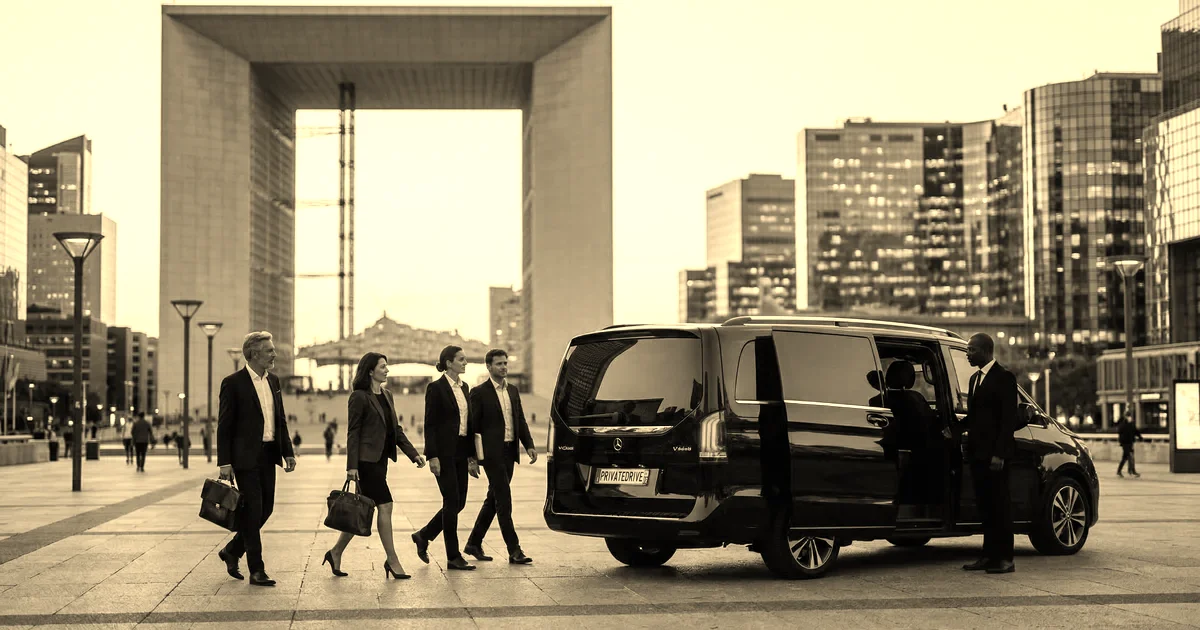
Paris. The French regulator ARPE reported 71,300 active VTC drivers in Île-de-France as of Q4 2025, operating under the same NAF 49.32Z code. Unlike London, France does not maintain a distinct licence category for premium chauffeurs. The “grande remise” designation, rooted in a 1955 decree, was legally absorbed into the broader VTC framework by the 2009 Novelli Act. The result: a flat regulatory structure where a solo driver in a Prius and a fleet of S-Classes compete under identical rules. Paris-based operators such as PrivateDrive represent the prestige tier of this bifurcation: fixed pricing, E/S/V-Class fleet, no algorithmic surge. The differentiation is commercial, not regulatory.
Berlin. Germany’s Personenbeförderungsgesetz (PBefG), amended in 2021, introduced a “gebundener Verkehr” category that covers app-dispatched services with a return-to-base rule. Blacklane operated under this framework. Post-acquisition, the question is whether Uber will maintain Blacklane’s Berlin hub as a standalone entity or fold its operations into Uber’s existing German licence. The BVG (Berlin transport authority) registered 9,400 active Mietwagen licences in 2025, a 31% increase since 2019.
| Metric | London (TfL) | Paris (ARPE) | Berlin (BVG) |
|---|---|---|---|
| Licensed PHV / VTC drivers | 114,200 | 71,300 | ~22,000 |
| Premium tier share (fleet) | 5.4% | ~4% (est.) | ~6% |
| Premium tier share (revenue) | ~12% | ~15% | ~10% |
| Separate premium licence | Yes (Chauffeur) | No | No |
| Top 3 platform concentration | 78% | ~85% | ~70% |
The table exposes a structural pattern. Premium chauffeur services represent a single-digit share of the fleet but a double-digit share of the revenue across all three capitals. This revenue density is exactly what makes the segment attractive to volume platforms, and exactly what makes it vulnerable to acquisition.
Directive 2024/2831: the regulatory accelerant
The EU Platform Workers Directive, adopted on 14 October 2024 under file 2021/0414(COD), establishes a rebuttable presumption of employment when a platform exercises “direction and control” over the worker. Member states have until 2 December 2026 to transpose it into national law. The directive lists five indicators of control, including algorithmic supervision of performance, restriction on the ability to refuse tasks, and determination of remuneration levels.
The impact on the bifurcation is asymmetric. Volume platforms rely on algorithmic dispatching, dynamic pricing, and performance ratings that collectively satisfy multiple indicators. If transposed strictly, the directive could reclassify tens of thousands of mass-market drivers as employees, raising operator costs by an estimated 20 to 35% according to Copenhagen Economics (2025 study commissioned by the European Commission). Spain’s early implementation via the Ley Rider (2021) offers a preview: Uber reclassified 2,100 couriers in Madrid within 18 months, absorbing higher unit costs.
Premium operators, by contrast, typically work with contracted chauffeurs under genuine B2B relationships. No algorithmic dispatching. No dynamic pricing. No performance-rating system determining access to trips. The directive’s indicators simply do not trigger. This regulatory asymmetry will widen the cost gap between the two tiers, accelerating the split. Mass-market platforms will face higher labour costs. Premium operators will not.
Defining luxury chauffeur standards across jurisdictions
What “premium” means varies by market, and this ambiguity benefits platforms that market algorithmic Black tiers as luxury without meeting the operational standard.
In the UK, the British Chauffeur Guild (BCG) published its 2025 Standard specifying: vehicle age under 3 years, minimum wheelbase of 3,100 mm (eliminating most sedans below E-Class), driver training in protocol and discretion (minimum 40 hours), advanced DBS check, and £10 million public liability insurance. TfL’s Chauffeur category mirrors these thresholds. Roughly 320 operators hold BCG accreditation.
France has no equivalent formal tier. The DGE’s “Qualité Tourisme VTC Limousine” label, launched in 2019, covers vehicle standards, multilingual capability, and service protocols. Fewer than 90 operators hold it nationally. The practical standard in the Parisian grande remise market is set by contract: corporate RFPs from luxury hotels, embassies, and multinational headquarters specify E-Class or above, bilingual chauffeur, and 24-hour availability with named backup.
Germany relies on operator self-certification under the PBefG. Blacklane’s internal standard required Mercedes E-Class minimum, professional attire, and airport meet-and-greet with flight tracking. Whether Uber will maintain these standards post-acquisition remains an open question.
The investor signal: valuation markers post-Blacklane
Private equity and venture capital flows into European ground transportation tell a clear story. Blacklane raised €45 million in its Series C (2022, led by Daimler Mobility AG), at an estimated valuation of €350 million. Uber’s acquisition price has not been disclosed, but Bloomberg sources cited a range of €400 to €500 million, representing a 1.1x to 1.4x premium over the last funding round in a depressed exit environment.
The premium paid tells investors several things. First, that Uber assigns strategic value to a premium brand it cannot build organically. Uber Black and Uber Lux have failed to gain traction with corporate procurement teams in Europe, partly because surge pricing is incompatible with expense-policy compliance. Second, that the acquirer expects regulatory tailwinds. If Directive 2024/2831 raises mass-market costs, operators with existing B2B contract structures (Blacklane’s core model) become relatively cheaper to operate. Third, that ground transportation is consolidating at the top. The global chauffeur services market, valued at $54.2 billion in 2024, is projected to reach $188.9 billion by 2033 (CAGR 13.3%, Allied Market Research). Capital is flowing toward operators who hold the premium position.
For independent luxury operators across Europe, the Blacklane exit sets a valuation benchmark. An operator with €10 million in annual recurring corporate contracts, E/S-Class fleet, and multi-city presence could reasonably command 3 to 5x revenue in the current environment. That multiple did not exist three years ago.
Where this leaves European premium operators
The bifurcation is no longer a market observation. It is a regulatory, financial, and operational fact. Three forces are locking it in place simultaneously: the DMA may constrain how volume platforms self-preference their premium tiers; Directive 2024/2831 will raise mass-market labour costs without touching B2B chauffeur contracts; and corporate procurement is shifting away from algorithmic platforms whose pricing cannot be pre-approved.
For operators on the prestige side, the strategic question is no longer whether the split exists, but how to defend the position it creates. Fleet age, chauffeur training depth, contract stability, carbon traceability per journey. These are the measurable differentiators that no algorithmic overlay can replicate. Uber can buy Blacklane. It cannot buy the trust a concierge at The Ritz places in a chauffeur he has worked with for four years.
Market Observatory
Market data, regulation, fleet electrification, premium tourism: B2B analysis of the VTC and premium chauffeur industry across Europe.
Browse the observatory →