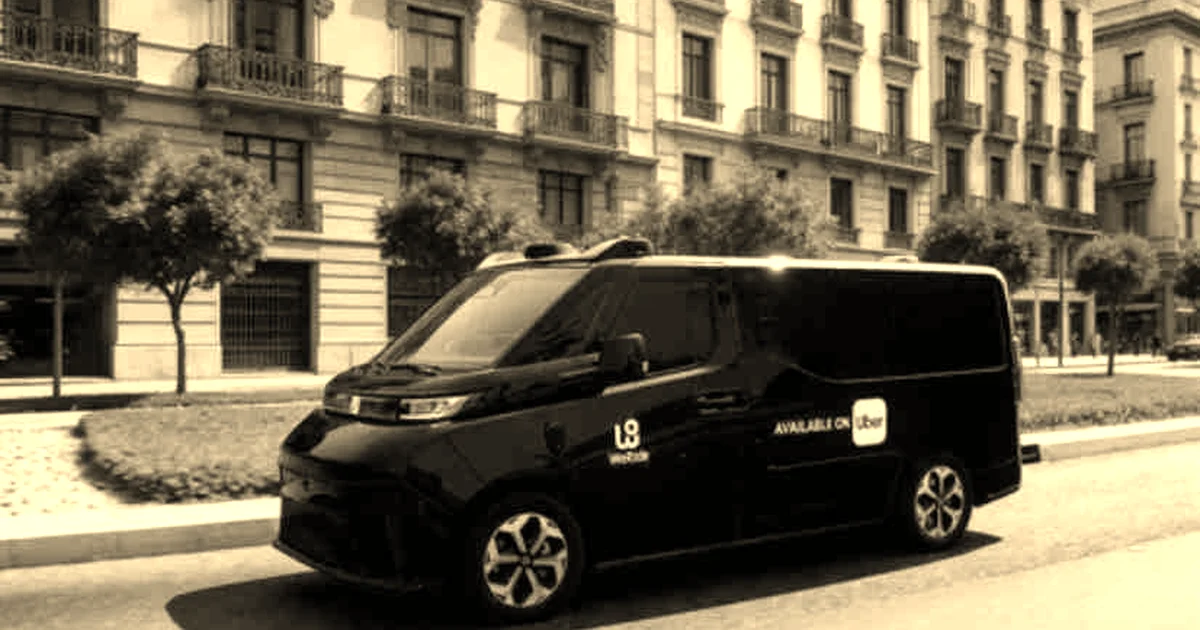
The press release landed this morning on the GlobeNewswire wire and travelled around the financial markets within hours. WeRide, Uber and AVOMO are bringing Spain’s first commercial robotaxi to Madrid in partnership with the Madrid regional authority. The Spanish capital becomes the twelfth WeRide city in the world and Uber’s fourth European autonomous beachhead in 2026, after London, Munich and Zurich.
For a European premium chauffeur operator, the news is not a piece of Spanish technology trivia. It confirms a pan-European dynamic that is shifting the centre of gravity of the transport value chain, restructuring the platform-operator balance of power in the standard segment, and redefining by contrast what a human-led premium service delivers that cannot be coded.
The day the robotaxi became a European Uber product
The 2 June 2026 announcement closes a file opened in autumn 2025, when Uber spoke of fifteen autonomous markets to open within the year. The 2026 calendar published then listed London, Madrid, Munich and Zurich for Europe, and Los Angeles, Houston, the San Francisco Bay Area and Hong Kong for the rest of the world. Six months on, the grid is filling cell by cell. London started in April with Wayve. Munich opened its trials with Momenta under strict geofencing and with the Autobrains software stack for reading complex urban situations. Madrid now takes the baton: WeRide supplies the autonomous driving technology, Uber supplies the customer app and dynamic-pricing layer, and AVOMO, part of the Moove Cars group, runs the fleet on the same model already operating for Uber in Atlanta and Austin.
Uber’s European artery is taking shape across four rolling half-years. Four cities, four technical partners, one shared platform. The autonomous transport value chain is already structured around allegiance to the platform rather than around territory or the incumbent operator. The European passenger who hails a WeRide robotaxi in Madrid in autumn 2026 will do so in the same app that offered a Wayve in London in March and will offer a Momenta in Munich in September. For the French market leader in the premium segment, the Uber aggregation playbook now rolling out across Europe takes on another density once it is read inside this sequence: the platform is advancing in parallel on the human premium-chauffeur segment and on the commercial robotaxi segment.
Waymo, Tesla, Zoox: the US cascade and its orders of magnitude
Europe is watching Madrid; North America is playing one category up. In May 2026 Waymo announced an expansion of its coverage to 1,400 square miles across eleven US cities. The operational fleet reaches roughly 3,000 vehicles, cumulative commercial rides pass 20 million, and the stated target is one million rides per week by the end of 2026. Twenty-six cities are now in the pipeline, including London and Tokyo as international outposts.
On 18 April 2026 Tesla switched its Dallas and Houston service to unsupervised and now charges around $0.81 per mile against $1.36 to $1.43 for Waymo. The carmaker presses on the underlying price grid but trails on service quality: average wait times above fifteen minutes against five and a half at Waymo. Tesla is targeting seven cities for the first half of 2026, with Phoenix, Miami, Orlando, Tampa and Las Vegas still to open. Zoox, the Amazon subsidiary, is due to launch its paid service in the second half of 2026 from a 220,000-square-foot assembly plant in Hayward, with a theoretical capacity of 10,000 vehicles per year. Analyst consensus puts the global robotaxi market at $198.6 billion in 2035, on a 66.7% CAGR with no equivalent in any adjacent transport segment.
The US figures do not transpose directly to Europe: the per-mile pricing model, suburban residential density, the federal regulatory philosophy and labour costs all change the equation. But they set an industry reference that rushed comparisons will recycle in the European press with every announcement. For the European operator the effect is not direct, it is reputational. The corporate buyer steering a 2027 transport plan reads these numbers on a dashboard, and then puts them to the supplier.
Hamburg, London, Munich, Madrid: the European grid fills in
Europe is assembling its own board, more slowly and more selectively. Hamburg has run a Mercedes and Volkswagen pilot with an onboard safety operator since 2024; the move to driverless is announced for late 2026. London started its Wayve autonomous trials in spring 2026 under a Transport for London licence, with passengers and an onboard technical minder. Munich enters service during the year with Momenta, with the Autobrains stack handling contextual reading of traffic situations. Madrid switches on in the second half of 2026 with WeRide and AVOMO. Zurich, Berlin, Leuven and Zagreb are on the list of Level 4 deployments expected over the same rolling period.
Paris is absent from this first grid. Waymo named the French capital as a future target in its October 2025 London announcement, without a delivered timeline. Renault has worked with WeRide for three years on the autonomous Robobus shuttle deployed at Roland-Garros, a choice that anchors the brand in collective mobility rather than in the individual autonomous vehicle. The French system still asks carmakers for proof through trials before opening a commercial Level 4 framework. For a player in the Parisian premium chauffeur market, the useful window is measured in eighteen to thirty-six months.
What European regulation refuses and what it accepts
The General Vehicle Safety Regulation 2019/2144 has been in force since July 2022 and forms the legal bedrock for type-approval of Level 3 and higher automated vehicles in the European Union. Germany legalised Level 4 early, with strict operator oversight, which explains the operational head start of Hamburg and Munich. France and Spain chose more cautious trajectories but are progressively aligning their frameworks with the common European doctrine.
A red line is nonetheless emerging. European regulators reject software stacks built on end-to-end artificial intelligence without decision traceability. That point weighs directly on the competitive advantage of each player. Mobileye and Wayve, familiar with the European compliance requirement, enjoy a presumption of conformity that their Californian counterparts build less easily. Uber’s choice to multiply technical partners in Europe rather than impose a single supplier reflects this regulatory fragmentation: each software stack is modelled for the national regulator it will serve.
Autonomy does not replace the premium chauffeur, it redraws its perimeter
The scenario taking shape in Europe does not threaten the premium chauffeur house on the same front as the standard ride-hailing tier. The robotaxi compresses the middle segment, the one sold mainly as a price alternative to the taxi and resting on the presence of a driver with no explicit service value. That is exactly the zone that the great split of the European ride-hailing market between volume and prestige has been mapping for eighteen months. The pressure of a driverless vehicle available at $0.80 per mile in the United States sets a mental anchor for the European customer, even if European reality will not reach that price level for several years.
The premium chauffeur house, in the historic French “grande remise” sense of the term, does not sell the journey. It sells the quality of the pick-up, command of the situation, the culture of the car and knowledge of the client. None of those assets is exposed to a WeRide or Wayve robotaxi in its 2026 version. The question for the operator is not whether it can drop its prices to robotaxi levels, it cannot. The question is whether it can clearly articulate, in the chauffeur brief, in training and in client communication, what does not get coded. That articulation is worth far more in 2026 than it was in 2024.
The companion French analysis Grande Remise published on the same 2 June, comparing the three great global capitals of prestige transport, confirms that the Paris market holds its rank on chauffeur selectivity and value-for-quality. The European robotaxi cascade reinforces that relative advantage rather than eroding it, provided the house consciously exploits the difference.
Three takeaways for the European operator
The first takeaway is about timing. The window during which Paris stays outside commercial robotaxi deployment lasts between eighteen and thirty-six months. That is the useful time to switch the fleet to the premium electric standard expected by European clients, to crystallise the service doctrine around human value, and to secure corporate contracts before the buyers’ comparison grid automatically includes the robotaxi as a budget alternative. The 2027 fleet electrification mandates across France, the UK and Germany are not only an environmental deadline, they become proof of modernisation in front of clients who are seeing driverless vehicles elsewhere.
The second takeaway is about platform dependence. The logic of allegiance to Uber emerging in Europe will replay on the robotaxi exactly as it played out on standard ride-hailing. The premium chauffeur operator who distributes most of its rides through a third-party platform will tomorrow depend on the same platform that distributes the competing robotaxi supply. The exit from that dependence is built today, through ownership of the end client, the corporate framework contract, the palace-hotel concierge relationship and the direct booking channel. Houses that have not locked in that commercial independence in 2026 will be at a disadvantage in 2028.
The third takeaway is about signature. The imminent arrival of a driverless vehicle in the landscape shifts the perceived value of the chauffeur. Presentation, language command, reading the traveller, managing silence, knowledge of the city all regain considerable relative weight. These are precisely the markers that the mapping of the European premium chauffeur market identifies as distinctive of houses positioned on palace prescription and high-end corporate work. The robotaxi reminds us, by contrast, what makes the premium chauffeur irreplaceable. The house that can articulate that difference capitalises on the announcement effect of the European robotaxi rather than suffering it.
The calendar that is closing
The Madrid sequence of 2 June 2026 is neither an isolated technological flourish nor the end of the European chauffeur. It marks the passage from a hypothesis to an operational calendar. Four European cities in commercial robotaxi service before year end, six to eight more in the 2027 grid, and an Uber geography that takes Europe in a pincer from the south, the north and the centre. From 2027 onward, the corporate buyer steering company transport will no longer be able to treat autonomy as a foresight topic. It will have to be arbitrated line by line in the specification. The premium chauffeur house that has moved early to document its human value wins that arbitration. The house that drifted along on the mid-premium tier slips below the waterline.
Sources and references
- BusinessWire / GlobeNewswire, WeRide, Uber and AVOMO press release, 2 June 2026: launch of Spain’s first commercial robotaxi in the Madrid region, AVOMO of the Moove Cars group as fleet operator, Madrid the twelfth WeRide city worldwide, scaling toward fully driverless operation.
- CnEVPost, 2 June 2026: operational detail on the service timeline expected for the second half of 2026, the strategic WeRide-Uber partnership in place since September 2024, and the prior Abu Dhabi and Dubai track record.
- Silicon Republic, Uber 2026 plan: London, Madrid, Munich and Zurich as European beachheads, 15 global Uber autonomous markets targeted for the year, partner portfolio spanning May Mobility, Lucid, Nuro, Baidu, WeRide, Wayve and Momenta.
- Technology.org and The Road to Autonomy: Munich with Momenta and the Autobrains software stack for contextual reading, strict geofencing and German Level 4 regulatory supervision.
- Autocar UK and S&P Global Mobility: Wayve and Uber London commercial trials in spring 2026, the European doctrine’s divergence from the US end-to-end AI model, and the compliance advantage of Mobileye and Wayve.
- Electrek, May 2026: Waymo 1,400 square miles across 11 US cities, roughly 3,000 operational robotaxis, 20 million cumulative rides, target of one million rides per week by end 2026.
- Tech-Insider and The Street, April-May 2026: Tesla unsupervised service in Dallas and Houston from 18 April 2026, pricing at $0.81 per mile against $1.36 to $1.43 for Waymo, average wait time 15 minutes against 5.7 at Waymo. Zoox commercial launch in the second half of 2026, Hayward plant 220,000 square feet.
- DataM Intelligence and Smart Cities Dive: global robotaxi market projection of $198.6 billion in 2035, 66.7% CAGR, top ten robotaxi suppliers 2026.
- Quiver Quantitative, 2026: WeRide’s third consecutive year of autonomous Robobus at Roland-Garros in partnership with Renault Group, a French strategy oriented toward collective mobility.
- Regulation (EU) 2019/2144: the European type-approval framework for Level 3 and higher automated vehicles, in force since July 2022.
The house PrivateDrive illustrates, on the premium-traveller segment, the systematic documentation of human added value that forms the main bulwark of the European premium chauffeur house against the 2026 commercial robotaxi cascade.
Market Observatory
The window during which Paris stays outside commercial robotaxi deployment is now counted in months. Grande Remise tracks every move in the European autonomous transport value chain and delivers the operational read for houses preparing the next decade.
Browse the observatory →