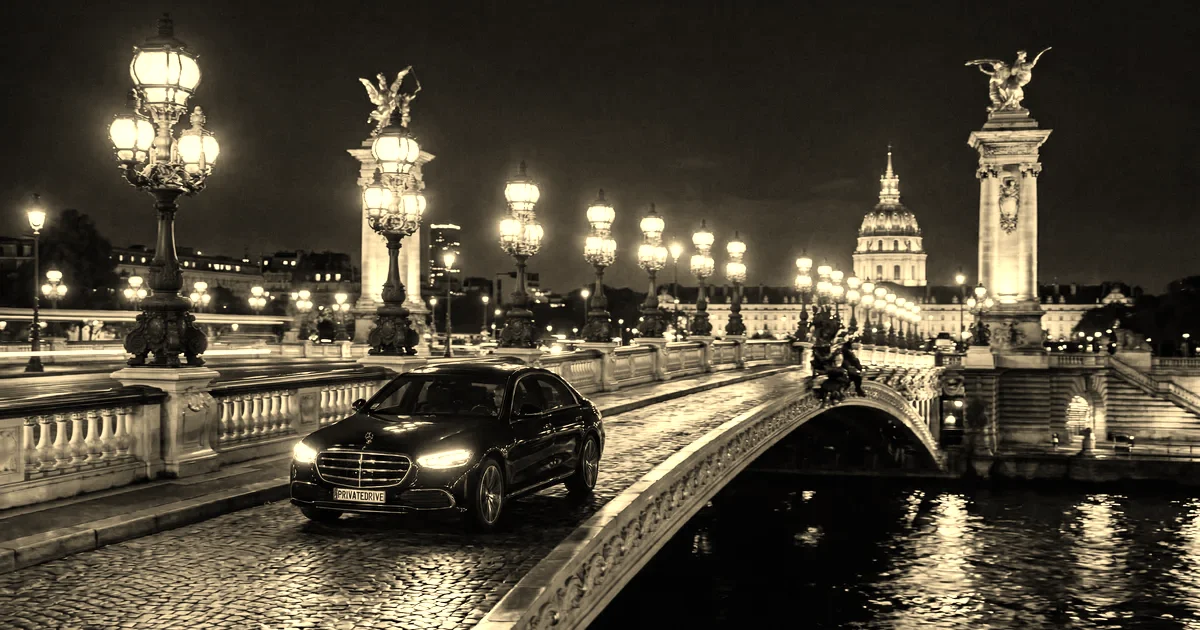
Six events anchor the 2026 European calendar of premium ground transport. Roland-Garros opens the cycle on 18 May with three weeks of dense, weather-volatile demand around the Bois de Boulogne. The Monaco Grand Prix detonates the Riviera weekend of 22-24 May. Royal Ascot follows in mid-June, then The Championships at Wimbledon. The BMW Berlin-Marathon closes the summer in late September, and the UEFA Champions League final caps the season at the end of May or beginning of June. Each event imposes a distinct logistical doctrine on the chauffeur operators that work them. Treated together, they describe the shape of the European premium ground transport market.
The numbers in 2025 set the baseline against which 2026 capacity will be allocated. Roland-Garros drew 630,000 spectators across qualifications and main draw, a record. Wimbledon recorded its highest aggregate ever at 548,770 visitors over the fortnight, with new daily highs on Days 9, 11 and 12. Royal Ascot registered 286,541 racegoers across the five-day royal meeting, up 4.8% on 2024. The Monaco Grand Prix sold out its ~37,000-seat grandstand capacity on Saturday and Sunday, with total weekend exposure estimated at 200,000 when balconies, yachts and harbourfront vantage points are included. The BMW Berlin-Marathon counted 55,146 runners on the streets and roughly one million spectators along the 42.195 km route, generating €469 million of measured economic output across four days. The Champions League final at the Allianz Arena delivered a single-shot capacity of approximately 75,000 spectators on 31 May 2025.
Six events, six different demand signatures
Spectator volume is the wrong number to read first. Premium chauffeur operators sell capacity to a sliver of the audience, and that sliver behaves differently at each venue. At Wimbledon, the Centre Court and No.1 Court Debenture holders, the AELTC hospitality programme, and the corporate boxes account for roughly 8 to 10% of the daily attendance but a meaningful majority of pre-booked private hire revenue. At Roland-Garros, the President’s Lounge, Pavilion VIP and Premium hospitality categories represent a similar share. At Monaco, the proportion inverts: the entire weekend is structured around high-net-worth attendance, with ratios of premium-to-mass that no other European fixture matches.
The Royal Ascot model sits between the two. Royal Enclosure admission is restricted by application and dress code, and Ascot Racecourse data shows a stable share around 25,000 per day across the meeting, embedded inside a total of roughly 57,000. The premium share is structurally higher than at a tennis Slam because the dress code itself filters audience composition. Berlin works on the opposite logic: a mass participant event whose premium audience is the visiting corporate sponsorship hospitality and the international elite runners’ entourages, both small in headcount but concentrated in the same five hotels around Tiergarten and Mitte.
The Champions League final is its own category. One night, one stadium, one city, with a guest population that includes UEFA committees, federation delegations, sponsor activation guests and HNW patrons travelling specifically for the fixture. Hotel capacity in the host city saturates roughly six weeks before the match. Premium chauffeur stock follows the same curve.
Modal split and why ground transport wins by default
At every venue the stadium itself is functionally closed to private vehicles for the general public. London transports Wimbledon attendees by Southfields and Wimbledon Park Underground, with shuttle buses from Southfields. Paris channels the Roland-Garros crowd through Porte d’Auteuil (line 10) and Boulogne-Jean Jaurès. Monaco closes circuit-adjacent districts entirely on race weekend; helicopter from Nice to Monaco-Fontvieille handles the upper segment, chauffeur from Nice Côte d’Azur or Cannes the broad premium tier.
Premium ground transport wins where the alternatives fail. Rail works for individual travellers but not for groups travelling with luggage, formal attire, or a tight hospitality schedule. Ride-hailing apps fail when surge pricing breaks expense-policy compliance and when algorithmic dispatch cannot accommodate a promised pickup outside a closed event perimeter. The chauffeur operator’s product is precisely what an algorithm cannot deliver: a known driver, a fixed price, a fixed waiting window, and the tactical knowledge of how to handle a closed perimeter. This dynamic underlies the broader structural divergence we set out in our analysis of the great split between luxury and mass-market European ride-hailing.
Helicopter remains a niche solution: Monaco and the Cup final cities use it heavily, Wimbledon and Roland-Garros rarely. Royal Ascot is the exception in horse racing where helicopter transfer to the on-site landing pad is a frequent option for the highest tier of guests; everyone else arrives by chauffeur from London or by train to Ascot station with a short walk.
Comparative table: the six 2026 events
The table below condenses the doctrine onto the variables that decide operational planning: spectator volume, premium share estimate, dominant ground transport mode, the typical chauffeur peak window, and whether bookings tend to flow through hotel concierges or directly to the operator.
| Event | 2025 spectator total | Premium share (est.) | Dominant ground mode | Chauffeur peak window | Booking channel |
|---|---|---|---|---|---|
| Roland-Garros (Paris) | 630,000 (3 weeks) | ~10% | Chauffeur from 16e palaces | 13:00–15:00 / 22:00–24:00 | Mostly hotel concierge |
| Wimbledon (London) | 548,770 (fortnight) | ~8–10% | Chauffeur from W1/SW3, Tube | 10:30–12:30 / 21:00–23:00 | Mixed concierge + corporate |
| Monaco Grand Prix | ~200,000 (4 days) | ~40% | Chauffeur from Nice/Cannes | 08:00–11:00 / 17:00–20:00 | Mostly direct B2B |
| Royal Ascot | 286,541 (5 days) | ~25% | Chauffeur from London W1 | 10:00–12:00 / 18:30–20:30 | Hotel + members’ clubs |
| BMW Berlin-Marathon | ~1,000,000 spect. + 55,146 runners | ~3% | Chauffeur within Mitte ring | 06:30–08:00 / 13:00–16:00 | Sponsor + elite runner contracts |
| Champions League final | ~75,000 (one match) | ~15% | Chauffeur from city hotels | 17:00–19:30 / 23:30–01:30 | UEFA + sponsor B2B |
Two patterns emerge. First, Monaco is an outlier on every dimension: the highest premium share, the most direct B2B booking, and the longest booking lead time of any event on the list. Second, the events with hotel-driven booking channels (Roland-Garros, Wimbledon, Royal Ascot) cluster around city centres with established palace inventories. The Champions League final follows the same logic on a one-night cycle. The Berlin-Marathon is structurally different because its premium demand sits inside sponsor activation rather than visiting spectatorship.
The peak window mechanics that decide the day
Tennis tournaments produce two peak windows per session day. The morning push from W1 hotels into Wimbledon Village or from the 8e and 16e arrondissements into the Roland-Garros perimeter sits between 10:00 and 12:30, depending on whether Centre Court starts at 13:00 or 13:30. The evening return is the operational hard problem: a five-set semi-final can finish between 20:00 and almost midnight, and the chauffeur must hold capacity inside a 15-minute drive of the venue without committing the vehicle to a competing trip. Real-time communication, geolocation pin sharing and a contingency parking route are the practical tools that distinguish a prepared operator from a reactive one.
Monaco compresses the same logic into a single 90-minute departure window after the chequered flag. The race ends around 17:00 local time, the perimeter reopens progressively over the next two hours, and the chauffeur stock that positioned in advance along the Boulevard de Suisse, Avenue Saint-Martin or in the Fontvieille tunnel exit zone collects clients in a sequence that has been pre-coordinated with the concierge team at the Hôtel de Paris, the Hôtel Hermitage or the Fairmont Monte-Carlo. Vehicles dispatched from Cannes or Nice must be on-position by 14:00 at the latest to avoid the closure rings.
Royal Ascot runs a more disciplined timetable. First race 13:30, last race 18:10, gates closed shortly after. The chauffeur peak window for return is therefore tight and predictable, between 18:30 and 20:30. Outbound from London is compressed between 10:00 and 12:00 because the dress code requires arrival before the Royal Procession at 14:00. The Berlin-Marathon, by contrast, demands an unusually early outbound at dawn (start gun 09:15, but elite warm-ups and sponsor hospitality begin from 06:30) and a long, dispersed return as runners and their parties leave hotels intermittently through the afternoon.
Hotel concierge logistics: the hidden distribution channel
The volume booking channel for premium ground transport at these events is not the operator’s direct line. It is the palace concierge desk. Roland-Garros, Wimbledon and Royal Ascot all see the same pattern: 60 to 75% of premium chauffeur missions originate from a Leading Hotels of the World, Forbes Five Star or Palace-classified property where the concierge team holds a multi-year relationship with one or two preferred transport partners. The economics for the operator are attractive but constraining: stable demand, premium price acceptance, and an obligation to deliver a service standard that the concierge stakes their own reputation on.
The Monaco model breaks this rule. Direct B2B contracts with sponsor hospitality programmes, family offices, automotive brand activations and wealth management firms account for the majority of the chauffeur stock during the Grand Prix. The Hotel Hermitage and Hotel de Paris remain critical nodes, but they sit alongside the Yacht Club de Monaco, the Sporting Club and dozens of corporate hospitality terraces that book their own ground transport directly. The lead time for premium vehicles in Monaco frequently begins in November or December of the prior year.
Berlin operates on a third logic. The marathon’s premium demand concentrates inside sponsor activation budgets (BMW as title sponsor, Adidas, Generali) and inside the elite athlete contingents managed by SCC EVENTS GmbH. The hotel concierge channel exists but is secondary. For chauffeur operators, this means the Berlin opportunity is a B2B contracting exercise with sponsor agencies several months in advance, rather than an inbound concierge stream during the race weekend itself.
The Italian and Spanish auxiliary cases
Two events anchor the Mediterranean spring tennis circuit before Paris. The Internazionali BNL d’Italia at the Foro Italico in Rome runs from early to mid-May and draws roughly 360,000 spectators across the fortnight. Its premium chauffeur demand concentrates around the Hotel de Russie, the Hassler and the Bulgari Hotel Roma, with peak volumes during the second week. The Mutua Madrid Open at Caja Mágica overlaps the same window with comparable, slightly lower spectator volume; the premium ground transport demand sits in the Salamanca district and around the Four Seasons Hotel Madrid.
Both events function as auxiliary cases for the same doctrine. They are smaller, follow tennis tour schedules with similar session-day rhythms to Roland-Garros and Wimbledon, and concentrate premium demand inside a small ring of luxury hotels. For cross-border operators expanding fleet utilisation across the May-June window, Rome and Madrid extend the Roland-Garros pattern by two weeks on each side, with similar booking behaviours and a slightly less competitive operator landscape.
The premium transport doctrine framework
From the six events surveyed, five operational variables converge on a coherent doctrine that European premium chauffeur operators apply, with local variation, across the calendar.
1. Booking lead time. Monaco sits at six to eight months. The Champions League final compresses to four to six weeks once the host city is confirmed. Roland-Garros, Wimbledon and Royal Ascot follow a four-to-twelve-week concierge booking pattern. Berlin sponsor contracts close earliest, often during Q4 of the prior year. The longer the lead time, the higher the operator’s incentive to dedicate vehicles exclusively to the event.
2. Vehicle stock under contract. A serious operator working Roland-Garros allocates 5 to 15 vehicles for the duration of the tournament; at Wimbledon, the equivalent comes from London chauffeur fleets sized between 8 and 30 vehicles. Monaco draws stock from across the Côte d’Azur and as far as Geneva and Milan. Royal Ascot sees UK-based fleets pre-block 20 to 50 vehicles for the week. Berlin sponsor contracts typically request 10 to 20 vehicles over the marathon weekend, with bilingual chauffeurs as a standard requirement.
3. Peak windows. Two-window days at tennis and racing events; a single high-intensity discharge at Monaco and the Champions League final; a dawn-plus-dispersed afternoon at Berlin. Operator dispatch desks sequence vehicles against these windows weeks in advance, not on the day.
4. Return-leg empties. The empty-mile cost is the operator’s structural challenge. A vehicle dispatched from Cannes to Monaco for an 18:30 departure runs deadweight both into and out of the Principality. At Wimbledon, the return from SW19 to W1 between 22:00 and 23:30 is fully paid but the next morning’s outbound is the same routing, meaning sequential round-trips with low compounding revenue unless a corporate retainer is in place. The economics of empty mileage track directly into the insurance and operating cost structure of premium chauffeur operations that European operators must manage.
5. Hotel-driven vs direct booking ratio. Roland-Garros, Wimbledon and Royal Ascot operate at roughly 60-75% concierge driven. Monaco inverts to 70%+ direct B2B. The Champions League final follows the UEFA hospitality programme through tier-one operators. Berlin runs sponsor contracts almost exclusively. An operator’s commercial positioning across the calendar is, in practice, defined by which channel mix they have built relationships against.
What the doctrine implies for 2026 fleet planning
The 2026 calendar adds two structural pressures. Roland-Garros moves its main draw to 25 May with finals on 7 June, slightly compressing the gap to Wimbledon’s 29 June start. Monaco GP runs 22-24 May, overlapping with the Roland-Garros first week and forcing operators with cross-border Côte d’Azur and Paris exposure to choose. The Champions League final on 30 May 2026 falls between the two majors, squeezing high-end vehicle stock further. Royal Ascot runs 16-20 June, and the BMW Berlin-Marathon takes place on 27 September.
The implication for fleet planning is that May and early June concentrate four major fixtures in five weeks, with the Champions League final as the swing variable. Operators with fleets above 15 vehicles can serve two events concurrently; below that threshold, the choice is strategic. The Mediterranean spring tennis tour (Rome and Madrid) extends the working window upstream, but does not relieve the May-June convergence. Berlin and Royal Ascot fall outside the cluster and operate as independent allocations.
For operators considering portfolio investment, the sequence also describes a maturity ladder. An independent chauffeur outfit typically begins at one local event (Roland-Garros for a Paris operator, Royal Ascot for a London one), demonstrates service consistency through the concierge channel, and only then negotiates the higher-margin sponsor or family office contracts that anchor Monaco and the Champions League final. The premium tier of the European chauffeur market is effectively gated by sporting event reputation, not by fleet size alone.
Sources and methodology
Sources. Roland-Garros 2025 attendance, Fédération Française de Tennis press releases, June 2025; The Championships Wimbledon 2025 attendance, All England Lawn Tennis Club official communication and Tennis Now reporting, July 2025; Monaco Grand Prix attendance estimates, Automobile Club de Monaco and Monaco Life, May 2025; Royal Ascot 2025 attendance, Ascot Racecourse and Racing Post, June 2025; BMW Berlin-Marathon 2025 statistics, SCC EVENTS GmbH press release and World Marathoner reporting, September 2025; UEFA Champions League 2025 final, UEFA.com Allianz Arena venue communication. Premium share estimates derive from venue hospitality category breakdowns where published; chauffeur fleet allocation ranges reflect aggregated industry reporting from European operator associations and are presented as orders of magnitude, not audited figures.
Market Observatory
Premium chauffeur logistics across European sporting and cultural calendars: B2B analysis for operators planning fleet allocation, concierge partnerships and sponsor contracts.
Browse the observatory →