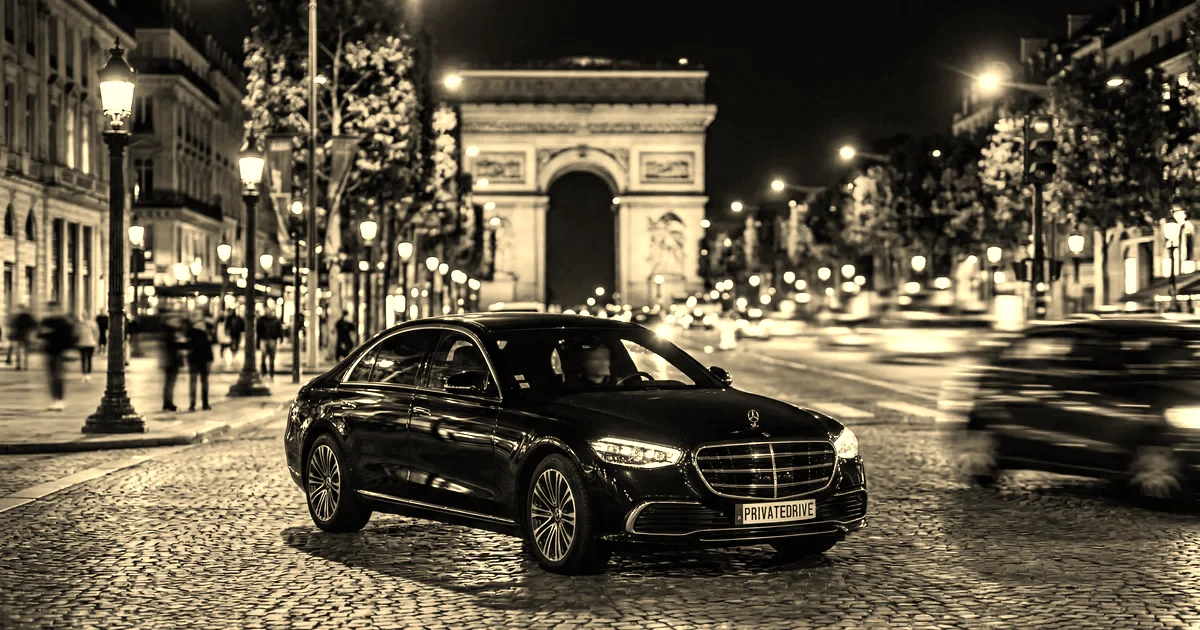
On 1 October 2024 the City of Paris SUV parking surcharge came into force, following the citizen ballot of 4 February 2024. Eighteen months on, the measure is no longer a point of friction; it is an operating parameter. Every Paris premium chauffeur operator has adjusted its waiting routines, some faster than others. Premium fleets, which rest almost entirely on saloons and vans above the 1,600-kilogram threshold, are the primary target.
The question is no longer whether the reform will last. It will. The question is to understand what eighteen months of enforcement have revealed about grey zones, fleet-composition tipping points, and the differential calibration between Paris, Lyon and Grenoble for an operator working across several major cities. Regulatory pressure also intensifies this summer with the Crit’Air 3 ban across twelve metropolises on 1 July 2026, which compounds the SUV surcharge for fleets still running combustion engines.
The pricing grid eighteen months on
The Paris scale rests on a single criterion: the kerb weight recorded in field G of the registration document. Combustion and plug-in hybrid vehicles above 1,600 kilograms move to the increased visitor tariff. Electric vehicles move at 2,000 kilograms. Two zones then define the amount: zone 1 covers the 1st to 11th arrondissements, zone 2 the 12th to 20th.
In zone 1, an hour of parking costs EUR 18 up to two hours, EUR 36 at the third, EUR 45 at the fourth, EUR 54 at the fifth. The six-hour cap reaches EUR 225. In zone 2, the hourly rate starts at EUR 12 and the cap at EUR 150. For comparison, a light saloon under 1.6 tonnes pays EUR 6 per hour in zone 1 and EUR 4 in zone 2. The gap runs from single to triple. The post-parking penalty (FPS) follows the same logic: EUR 225 in zone 1 for a heavy vehicle against EUR 75 for a light one.
The first fifteen minutes remain billed at EUR 4.50, which neutralises the temptation of paid quick drop-offs. A chauffeur waiting forty-five minutes outside a palace hotel in the 1st arrondissement with a 2.1-tonne Mercedes V-Class pays EUR 13.50 if the car is parked on-street. An hour and a half of waiting brings the bill to EUR 27. The sum is trivial per unit; it becomes structural once you multiply it by ten pick-ups a week per vehicle.
Chauffeurs in the grey zone: no formal exemption, and a pre-existing ban
The list of Paris exemptions from the SUV surcharge is exhaustive. It covers residents declared in their zone, taxis at their dedicated ranks, registered tradespeople and health professionals, holders of an inclusive-mobility parking card, and certain professionals on a mobile subscription. The chauffeur does not appear. No category was created for the sector, neither in the original text nor in the successive amendments.
That absence might look like a loophole. It is not really one. The prefectoral order of 31 December 2014, never repealed, already bans chauffeurs from parking on the public highway while waiting for a client without a booking. After a job, the driver must return to the company’s registered office, to home if self-employed, or to an off-street location where parking is authorised. The SUV surcharge therefore creates no new prohibition. It financially reinforces an obligation that already existed, and which many operators ignored or worked around.
The live case remains the waiting window between a confirmed booking and the pick-up. A chauffeur waiting with a firm named booking is not in breach of the 2014 order. But he remains fully subject to the visitor tariff if he occupies a metered space. Exemption from payment does not follow from professional status. It is documented, or it is paid.
The 2-tonne electric threshold as an arbitrage lever
The calibration asymmetry between combustion and electric is the most interesting point of the reform for a premium operator. The 1,600-kilogram combustion threshold excludes nearly every prestige saloon from the compliant categories. A Mercedes S-Class W223 weighs between 2,015 and 2,320 kilograms depending on the engine. A BMW 7 Series G70 starts at 2,040 kilograms in petrol form and rises to 2,380 as a plug-in hybrid.
The 2,000-kilogram electric threshold recovers part of the premium fleet. The Mercedes EQE 350+ weighs 2,295 kilograms; it stays subject to the increased tariff. The BMW i7 xDrive60 weighs 2,795 kilograms; it is in the bracket. The Tesla Model S Plaid tops out at 2,162 kilograms; it pays too. The Mercedes EQS 450+ reaches 2,480 kilograms; it pays as well. The 2-tonne threshold is barely cleared by genuine chauffeur saloons. It is cleared by certain Tesla Model 3 Long Range configurations at 1,848 kilograms, by some Peugeot 408 hybrids, by the base Polestar 2. Those are fleet choices premium operators do not make, except at the low-volume end.
The Mercedes EQS versus Tesla Model S comparison seen from the trade takes on a regulatory dimension here that was not in the original decision grid. Weight used to be only a comfort and range variable. It becomes a Paris operating-cost variable, to be modelled over the vehicle’s life cycle.
Paris, Lyon, Grenoble: three thresholds for a mobile fleet
An exclusively Paris operator manages a single grid. The multi-city operator faces three frameworks. Lyon, since June 2024, has settled on lower thresholds than Paris: 1,525 kilograms for combustion, 1,900 kilograms for plug-in hybrids, 2,100 kilograms for electric. The Lyon visitor tariff doubled from EUR 2 to EUR 3 per hour, the ten-hour cap from EUR 60 to EUR 80. The heavy-vehicle resident subscription rises from EUR 30 to EUR 45 per month.
Grenoble applied its own mechanics from 1 March 2024: a 10% surcharge on public car-park subscriptions for combustion vehicles above 1,550 kilograms and hybrids or electric above 1,800 kilograms. The on-street hourly ticket follows the same logic. Three cities, three calibrations, and a Grenoble electric threshold that captures models the Paris threshold lets through. A Tesla Model 3 Long Range, spared in Paris, falls under the Grenoble tariff.
For the electrification trajectory of premium chauffeur fleets across France, the UK and Germany, the consequence is moderately perverse. Model selection turns on marginal weight as much as on range or client comfort. A fleet manager acquiring fifteen EQS for the Paris headquarters and ten EQE for the Lyon branch already reasons in terms of weight-driven billing per geographic deployment. The logic was theoretical in 2023. It entered the decision sheets in 2025.
The LEZ convergence of 1 July 2026
The 2026 calendar superimposes two schemes that were not designed together. On 1 July, vehicles rated Crit’Air 3, 4 and 5 are banned in twelve French metropolises, including Paris, Lyon, Marseille and Lille, on the calendar confirmed by the Metropole du Grand Paris in the first quarter of 2026. Around 40,000 chauffeurs are affected nationally. The average acquisition cost of a compliant electric vehicle is estimated at EUR 45,000, with public subsidies covering on average 17% of the total cost.
The conjunction of the LEZ calendar and the SUV surcharge restructures the renewal calculation. An operator running a Mercedes S-Class 350d Crit’Air 2 must already treat it as a short-lived asset: it stays LEZ-2026 compliant but pays for every hour of waiting in zone 1. A BMW i7 or Mercedes EQS investment above 2 tonnes escapes the LEZ calendar but falls under the surcharge. No premium model ticks both boxes at once, short of moving down a segment. The read on European limited-traffic and low-emission zones for chauffeurs takes on particular relief once coupled with weight-based pricing.
The workable exit lies in function-based arbitrage. A mixed fleet, reserving the S-Class and EQS for outbound missions (airport transfers, VIP work in the regions) and deploying sub-2-tonne models for central jobs, optimises the LEZ-surcharge pairing. Operational intelligence becomes a competence in its own right, at the same level of demand as chauffeur training or manufacturer maintenance.
The operational responses consolidated in 2026
Eighteen months have fixed four lines of conduct that structure the operator response. The first concerns underground car parks. Q-Park, Indigo, Vinci Park and Saemes offer standard hourly rates independent of vehicle weight. Spaces near the palace hotels of the 1st, 8th and the Marais have become tactical positions negotiated quarter by quarter. Several operators have contracted monthly packages with two or three operators, reviving practices that early-century grande remise houses already followed.
The second line concerns active rotation. Rather than immobilising a saloon during a client’s brunch hour at the Crillon, the chauffeur runs a loop outside the central zone and returns exactly at the communicated time. The practice has a fuel or charging cost; it cancels the parking cost. The maths holds when the client does not impose immediate standby and when the surrounding urban fabric allows a legible loop.
The third line is documentary. Structured operators have written internal protocols of around ten pages defining, zone by zone and duration by duration, acceptable, tolerated or prohibited behaviours. These documents serve ongoing chauffeur training and operational justification toward corporate clients who probe the full cost of a service. Documenting one’s own compliance has become a commercial argument among fleets of more than ten vehicles.
The fourth line is fleet arbitrage proper, at the moment of renewal. The 2027 mandate of 50% electric fleet that lawmakers set for the chauffeur sector now interlocks with the Paris weight grid. Choosing an electric saloon compliant with the mandate is not neutral: its Paris operating weight depends on the model. Total cost of ownership is now computed across four dimensions: acquisition price, energy, maintenance and regulatory parking.
Exposure differs by fleet size
The SUV surcharge does not weigh the same depending on the size of the structure. An operator of twenty vehicles or more absorbs the costs through pooled logistics: car-park packages, centralised dispatch, fleet telematics that steer chauffeurs toward zone 2 rather than zone 1 while waiting. The marginal cost per vehicle falls to a few tens of euros a month.
The individual sole-trader chauffeur, running one to three cars, is exposed without a buffer. On ten weekly central-zone pick-ups with an average wait of thirty minutes, the monthly bill sits between EUR 300 and EUR 400, the equivalent of two days of fuel or a month of professional phone service. This lopsided exposure mechanically reinforces consolidation of the segment, whose contours the 2025 and 2026 sector mappings of the European premium chauffeur market already document.
An unexpected side effect: operators positioned on the premium segment have sometimes welcomed the reform. The surcharge raises the barrier to entry into the trade and marginalises players whose offer rests on taking regulatory risk. A chauffeur who absorbs the logistics cost while maintaining service quality marks the difference against the low-cost Uber ride that never pays for structured parking.
2026 political cycle and outlook
The March 2026 municipal elections put the place of the car in the city back at the centre of debate. Several Paris candidacies proposed adjustments to the surcharge; none proposed abolishing it. The scheme’s accounts, even though they remain below the initial forecasts owing to low voluntary compliance and mass challenges, make it a budgetary lever the next council will have little interest in dismantling.
The likely direction of the 2026-2030 cycle is extension rather than retreat. Marseille, Bordeaux, Toulouse, Nantes and Strasbourg all hold the regulatory tools to set their own SUV grids. Extending Paris to the 12th-20th arrondissements with a unified zone-2 tariff remains a working hypothesis of the city’s technical services. The electric weight threshold could be revised downward, toward the 1,800 kilograms used in Grenoble, a measure several environmental groups are preparing for the 2027 cycle.
For the premium chauffeur sector, the cycle now opening therefore demands a rolling-horizon read. Acquiring a vehicle in 2026 on compliance with the current thresholds alone does not immunise against a shift of the framework in 2028. Operational leasing contracts negotiated today now embed a regulatory-adjustment clause, and some manufacturers support their professional fleets with a comparative analysis service for metropolitan thresholds. What was once a technical line on a product sheet becomes a strategic asset in the purchasing decision.
Reading the cycle
The SUV surcharge is not an isolated event. It belongs to the fabric Paris has deployed since the start of the decade to reshape the car footprint in the dense centre: Paris Centre limited-traffic zone, progressive Crit’Air 2 low-emission zone, ring road at 50 km/h, extended Sunday pedestrian perimeter. The real difference between a premium chauffeur operator that rides through the cycle and a player that suffers it is not measured on the technical compliance of the fleet; it is measured on the ability to turn each new constraint into a relationship argument toward the client. The corporate buyer signing off a 2026 pricing grid expects from its transport partner a documentary command that goes well beyond the SUV question. It expects an integrated read of the Paris and national framework. It is that read, even more than the fleet itself, that now distinguishes the structured operator from the opportunistic driver.
Sources and references
- City of Paris, deliberation on the parking pricing of heavy vehicles adopted after the citizen ballot of 4 February 2024 (54.55% in favour, 5.68% turnout), in force from 1 October 2024, thresholds 1,600 kg combustion and 2,000 kg electric, visitor tariff EUR 18/hour and six-hour cap at EUR 225 in zone 1, EUR 12 and EUR 150 in zone 2.
- Paris Police Prefecture, 2014 order of 31 December banning on-street parking for chauffeurs waiting for a client without a booking, never repealed, articulated with the Paris parking reform.
- Metropole du Grand Paris, application calendar of the metropolitan low-emission zone, Crit’Air 3 ban across twelve French metropolises on 1 July 2026, Paris, Lyon, Marseille, Lille perimeter, around 40,000 chauffeurs impacted nationally, average compliant-EV acquisition cost EUR 45,000 and estimated public-subsidy coverage of 17%.
- City of Lyon, heavy-vehicle parking scheme in force since June 2024: thresholds 1,525 kg combustion, 1,900 kg plug-in hybrid, 2,100 kg electric. Visitor tariff increased from EUR 2 to EUR 3/hour, ten-hour cap raised from EUR 60 to EUR 80, heavy-vehicle resident subscription rising from EUR 30 to EUR 45 monthly.
- City of Grenoble, scheme applied from 1 March 2024: 10% surcharge on public car-park subscriptions for combustion vehicles above 1,550 kg and hybrids or electric above 1,800 kg.
- Mercedes-Benz, BMW and Tesla manufacturers, official technical sheets for the premium saloons affected by the Paris thresholds: S-Class W223 (2,015-2,320 kg), 7 Series G70 (2,040-2,380 kg), EQS 450+ (2,480 kg), i7 xDrive60 (2,795 kg), Model S Plaid (2,162 kg), Model 3 Long Range (1,848 kg), EQE 350+ (2,295 kg).
Regulation
The SUV grid is no longer a one-off constraint. It is a structural component of the operating calculation of a Paris premium chauffeur operator, interlocked with the 2026 low-emission zone, the 2027 50% electric fleet mandate and the specific thresholds of Lyon and Grenoble. Grande Remise documents the evolution of metropolitan regulatory schemes and their effect on sector practice every quarter.
Browse the observatory →