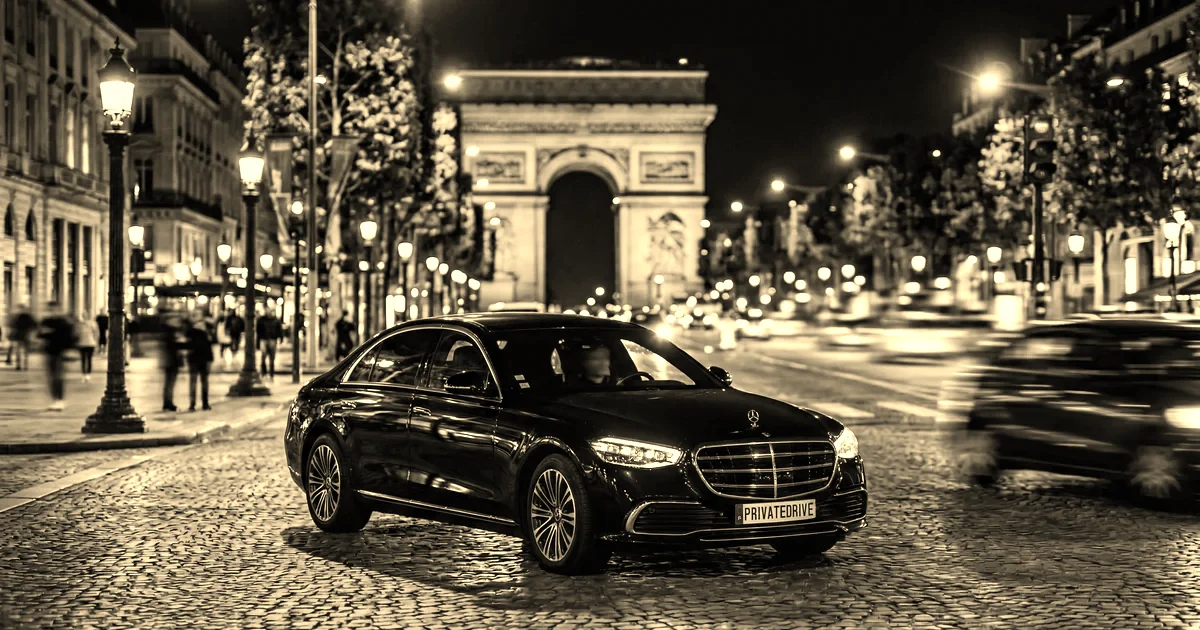
A guest stepping out of a car at the Four Seasons George V, the Savoy, the Hôtel de Paris Monte-Carlo or the Mandarin Oriental Milan registers a single thread of experience. The ride that brought them from the airport and the welcome at the porte-cochère are not, in the guest’s memory, two services. They are one. The concierge who arranged the car knows this better than anyone. Everything that breaks the thread comes back to the desk, and everything that holds it adds to the concierge’s standing among peers.
For a premium chauffeur operator running cross-border European routes in 2026, understanding the mechanics of that prescription matters more than any acquisition campaign. A palace concierge desk does not respond to a rate card. It responds to reputation accumulated run after run, and that reputation travels through a network with its own rules, its own grading system, and a memory measured in years. The network has a name. The grid that filters transport partners is more precise than most operators assume.
Les Clefs d’Or: the grammar of prescription
The Union Internationale des Concierges d’Hôtels, known by its emblem as Les Clefs d’Or, was founded in Paris in 1929 and is headquartered at 12 rue Cambon, a few doors from the Ritz. It federates roughly four thousand professional hotel concierges across more than fifty countries. The nine founding nations of the international federation in 1952 were Belgium, Denmark, France, Germany, Ireland, Italy, Spain, Switzerland and Great Britain, which is precisely the European geography that still concentrates the densest cluster of qualifying members today.
The two crossed golden keys worn on the lapel are not decoration. They signal that a peer commission has validated a minimum of five years in post as a working concierge, letters of recommendation from existing members, and a verified record of execution at the establishment. The keys are not transferable and not bought. A concierge who loses standing in the community loses the informal authority that the keys represent, even while keeping the pin. The distinction matters to a transport operator because it identifies exactly which desks act as nodes in the referral network and which do not.
Europe holds an outsized share of that geography. The Four Seasons George V in Paris reported eleven Clefs d’Or concierges on a team of sixteen in 2025, the highest concentration ever assembled under one roof. London, Geneva, Milan and Monaco operate at comparable ratios across the Savoy, the Dorchester, the President Wilson, the Mandarin Oriental and the Hôtel de Paris. Local density is not anecdotal for a transport operator. It means prescription circulates in a short loop. A clean execution propagates across a city’s concierge community within days, and a failure fixes itself there at the same speed.
Why transport is not a peripheral service
Studies of the high-end segment place arrival and departure between fifteen and twenty-five percent of total stay satisfaction. A missed transfer, or one handled with approximation, contaminates the memory of the three or four nights that follow. The concierge knows that the quality of the hotel experience begins fifty kilometres before the door and ends sixty minutes after it. The car is not an add-on to the stay. It is the frame around it.
That single fact shapes the entire practice. Recommending a transport provider stakes the concierge’s personal reputation far more than the hotel’s. A repeated failure removes the partner from the ledger. A single but visible failure, on a VIP guest or a high-stakes booking, can be enough. The hotel never retracts publicly. It simply stops placing the order, and the operator often learns of the demotion only by the silence on the dispatch line.
The six criteria that filter transport partners
Conversations with chief concierges across the major European houses converge on six requirements that any transport provider must satisfy before regular prescription becomes possible. The first three are non-negotiable thresholds. The last three differentiate a permanent partner from an occasional fallback.
1. Fleet depth and consistency
A palace desk needs to know that a request for a long-wheelbase S-Class on a Tuesday evening will be met by the same standard of vehicle as the one delivered the previous month, and that a sudden call for three cars to a single departure can be honoured without a downgrade. Electrified flagships have entered the grid alongside the thermal S-Class rather than replacing it: the EQS, the i7 and the e-tron GT now meet the standard at houses with documented sustainability commitments, and a guest from a corporate account with a Scope 3 reporting obligation increasingly expects the option. Fleet depth is what lets a concierge promise without checking.
2. Absolute reliability, measured by event not by average
Zero late airport transfers, zero unannounced replacement vehicles, zero last-minute chauffeur substitution. The desk does not reason in average service rates. It reasons by event. A flight missed because of a late chauffeur erases two years of clean performance. This is where a formal service level agreement earns its place: a documented commitment on pickup windows, flight tracking, no-show protocol and escalation contact converts a promise into something the concierge can rely on under pressure. A missed connection is not a statistic to a concierge. It is a guest standing in a terminal with the desk’s number in hand.
3. Chauffeur conduct as an extension of the house
Impeccable dress, a vehicle prepared at every pickup, a professional posture that never slides into familiarity. The chauffeur recommended by a palace concierge is read, from the first second of contact, as an extension of the hotel team. The guest passes from the car to the porte-cochère without a stylistic break. Door etiquette, luggage handling, route discretion and silence when silence is wanted are not soft skills in this segment. They are the product. Houses aligned with Forbes Travel Guide standards audit this conduct on the same scale they apply to their own staff.
4. Discretion and NDA as attitude, not just clause
The palace segment receives public figures, ruling families, executives mid-negotiation and artists on tour. A chauffeur commenting on a run, even anonymised, is enough to be struck from the ledger. Discretion is not guaranteed by a contract or an internal charter alone, though a signed non-disclosure agreement is now standard at the top end and increasingly a procurement requirement. It is verified in informal conversation between concierges, on what has or has not leaked into the community over recent months. The same data-handling rigour that European operators apply under the GDPR obligations governing passenger data now extends to itinerary confidentiality as a reputational asset, not merely a legal one.
5. Insurance and coverage that survive scrutiny
A palace desk that recommends a transport partner inherits a share of the liability exposure when something goes wrong. Chief concierges and hotel risk managers increasingly ask for proof of commercial passenger-carrying insurance, contractual liability cover and a clear position on cross-border operation before a partner is added to the approved list. The European premium segment has tightened here since 2024, and an operator who cannot produce a current certificate on request does not enter the grid. The structure of that cover, and the gaps that catch operators running across multiple jurisdictions, sit at the centre of professional liability insurance for luxury chauffeurs in Europe, and a concierge who has been burned once reads the certificate line by line.
6. Billing integration with the guest folio
The detail that separates a true hotel partner from a competent independent is the ability to bill onto the guest folio cleanly, under a single corporate account, with itemised documentation that the hotel finance office accepts without query. A guest who pays the chauffeur in cash at the kerb is a friction point. A guest whose airport transfer appears on the folio alongside the spa and the restaurant has never left the hotel’s service envelope. After-hours dispatch with single-contact authority, consolidated monthly invoicing and a traceable audit trail are what let the concierge place a car at three in the morning without a finance conversation.
The selection grid, weighted
The six criteria do not carry equal weight, and the weighting shifts with the profile of the booking. The grid below sets out how chief concierges across the major European houses describe the relative importance of each criterion, the typical threshold a partner must clear, and the failure mode that removes a partner from the ledger. The asymmetry between weight and forgiveness is the line worth reading: reliability carries the highest weight and the lowest tolerance, while fleet depth is heavily weighted but recoverable.
| Criterion | Weight | Threshold to enter the grid | Failure that removes the partner |
|---|---|---|---|
| Reliability / SLA | Very high | Documented SLA, flight tracking, no-show protocol | One missed flight or unannounced substitution |
| Discretion / NDA | Very high | Signed NDA, verifiable record of silence | Any leaked detail about a guest |
| Chauffeur conduct | High | Forbes-grade dress, etiquette, language | Familiarity or visible lapse on a VIP run |
| Fleet depth | High | Consistent flagship vehicles, surge capacity | Repeated downgrade or refusal at peak |
| Insurance / coverage | Medium-high | Current certificate, cross-border cover | Inability to produce proof on request |
| Billing integration | Medium | Folio billing, single account, audit trail | Kerb cash demands, opaque invoicing |
The weighting is not uniform across cities. In Geneva and Monaco, where the resident and ultra-high-net-worth clientele dominates, discretion and chauffeur conduct climb to the top of the grid and billing integration recedes because much of the business runs through family offices and standing accounts. In London and Milan, where corporate and event traffic is heavier, billing integration and fleet depth rise, since a single booking may involve a dozen cars invoiced to one account inside forty-eight hours. A Paris palace sits between the two, with reliability under the airport constraint as the permanent first filter.
Referral economics under the code of ethics
The question of commissions is the most misread part of the relationship by operators arriving from the mass-market side. Les Clefs d’Or maintains a code of ethics that does not ban referral benefits outright but disciplines them precisely. A concierge should recommend a product or service only after an objective, independent assessment, and never on the sole basis of benefit to the concierge. Any benefit received for a recommendation must be transparent and shared with the desk team. A concierge may not demand a benefit in exchange for a recommendation, nor promise one in exchange for payment.
Read against that standard, the operating economics are clear. The opaque kickback is not merely frowned upon, it is the fastest way to be permanently struck from a network that talks to itself constantly. A transport operator who offers an envelope to one concierge has, in effect, advertised the offer to every concierge that person speaks to. What the code does permit is transparent, team-wide arrangements: standardised loyalty schemes, in-kind courtesies offered equally to all concierges at a house, and disclosed referral structures booked through the hotel rather than the individual. The legitimate commercial lever remains punctuality, vehicle quality, chauffeur training and the documentary traceability of the service. The economics reward consistency, not generosity.
The pricing context reinforces the discipline. Paris luxury and upper-upscale hotels reached an ADR of 514 euros and a RevPAR around 444 euros in peak June 2025, with further upgrades forecast through 2026 on Middle Eastern demand and displacement from Milan. Milan’s own rates surged on the 2026 Winter Olympics, with February ADR projected near 300 euros, up close to fifty percent year on year. London hit record monthly highs above 234 pounds ADR in July 2025. A desk defending room rates at that level does not defend a cheap transfer. It defends an experience that justifies the price of the room, and a transfer priced correctly belongs to that equation while a discounted one undermines it.
The relationship lifecycle: from first run to the ledger
Entering a palace concierge ledger takes, as a rule, eighteen to thirty months. The path runs through a less-exposed guest referred by a five-star desk, then a last-minute rescue accepted without hesitation, then a sequence of flawless runs whose guest sentiment filters back to the desk. Frontal commercial approaches, brochures, general presentation decks, close more doors than they open. The sector sponsor, the professional association, the respected peer who picks up the phone are the natural vehicles of entry into the circle. The grid that defines the European palace hotel chauffeur partnership standard is the same one a concierge applies before the first introduction is ever made.
Once prescription is engaged, the relationship is maintained run by run, never renewed by contract. The European premium traveller of 2026 measures the quality of the partnership by the calm of the journey, the precision of the in-cabin explanations, and the absence of operational surprise between the arrival gate and the porte-cochère. The concierge measures it by what the guest says afterward and by what the operator does when something goes wrong at one in the morning. An operator who recovers a failed transfer flawlessly often gains more standing than one who simply never failed, because recovery is the truest test of depth.
The peaks compound the stakes. The European luxury calendar in 2026 stacks two fashion seasons in each major capital, the Milano-Cortina Winter Olympics, the Cannes and Venice festivals, Art Basel in Basel and Paris, and a dense gastronomic circuit. Each peak activates a pre-wired transport logistics that the desk needs cabled six weeks ahead, with language coverage specified, routes validated on the previous off-season, and access credentials already secured. The relationship between fine dining and ground transport is one such circuit: a guest moving between a three-star table and the hotel expects the same seamlessness the kitchen delivers, which is why Michelin gastronomy tourism and premium transport have become operationally inseparable at the top of the European market. At those moments the concierge does not arbitrate on the price per kilometre. The desk arbitrates on the certainty that nothing will collapse.
An operator who builds this grid into the firm to the point of making it the signature will not be compared to dynamic-pricing platforms. They will be compared, by the chief concierges of a handful of European houses, to two or three peers and to those peers alone. That relative position, never published and never advertised, is what determines real market share in European prestige transport. It is also the most inelastic commercial asset in the segment, because it cannot be bought, only earned, and once earned it does not move on price. Operators structuring this kind of integration across Paris, the airports and the wider European circuit can study how PrivateDrive positions its fleet against palace-desk expectations rather than against platform tariffs.
Sources: Union Internationale des Concierges d’Hôtels (Les Clefs d’Or), organisational profile and history, founded Paris 1929, headquartered 12 rue Cambon, approximately 4,000 members across more than 50 countries; Les Clefs d’Or code of ethics on recommendations and referral transparency; Four Seasons Hotel George V Paris, 2025 communication on 11 Clefs d’Or concierges on a team of 16; CoStar / STR Global Hotel Market Forecast Assumptions, February 2026; STR Paris and London luxury and upper-upscale ADR and RevPAR data, June and July 2025; Travel And Tour World and STR commentary on Milano-Cortina 2026 hotel rate impact; Forbes Travel Guide service standards for chauffeur and concierge interaction.
Tourism & Prestige
A palace concierge’s prescription is not bought, it is earned through operational rigour sustained over time. Grande Remise documents the dynamics of premium prescription across European markets and what they mean for operators aiming to enter the circle.
Browse the observatory →