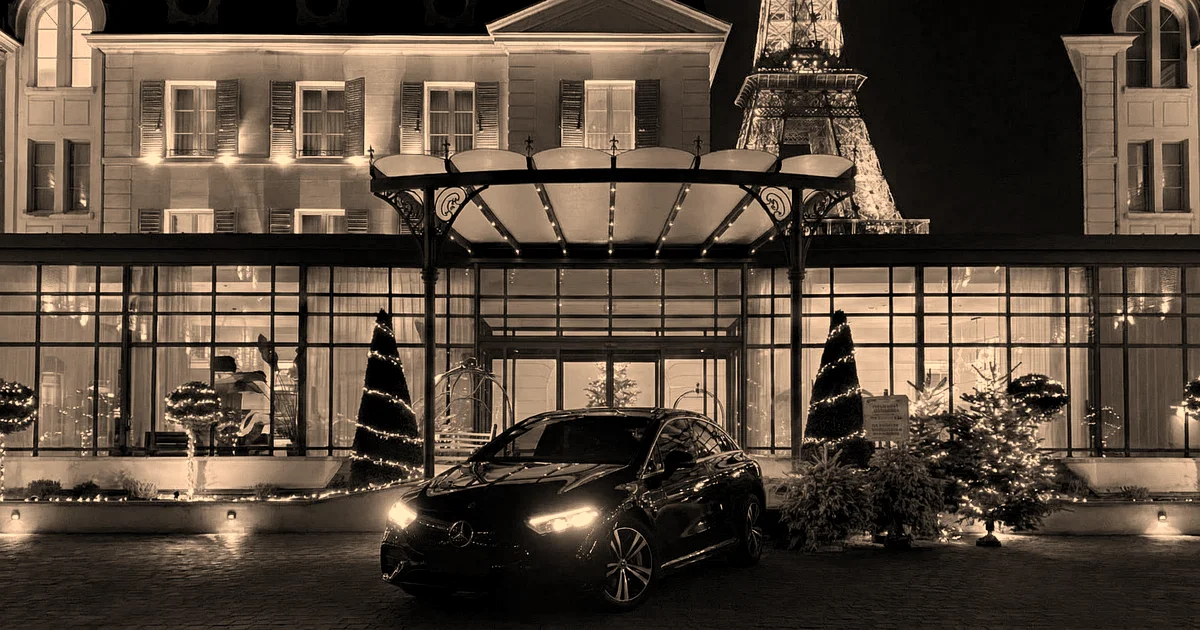
A three-star reservation is not a meal. It is a fixed point in a traveller’s week, booked three to six months in advance, around which an entire trip is organised. Europe holds the densest concentration of these fixed points on the planet. As of August 2025 the Michelin Guide recognised 157 three-star establishments worldwide. France alone accounted for 31 of them. Add Spain, Italy, Germany, the United Kingdom, Switzerland and the Nordic countries and the continent carries well over half the global total. For the premium chauffeur sector, that density is not a cultural footnote. It is a demand map.
The gastronomic traveller behaves unlike any other premium client. The dinner is non-negotiable and time-stamped to the minute. The itinerary often chains two or three establishments across an evening, or a city restaurant against a vineyard sixty kilometres out. The wait between courses runs three to four hours. And the person who holds that evening together, who positions the car without blocking a narrow street in the Marais or the Gothic Quarter, who is parked and warm when a four-hour tasting menu ends twenty minutes early, is the chauffeur. This article maps where European gastronomy tourism concentrates, what it is worth, and what a transport partner actually has to deliver.
The European three-star map: where the demand sits
France remains the structural anchor. The 2025 Guide confirmed 31 French three-star restaurants, a count no other country approaches. The Paris cluster (Arpège, Pierre Gagnaire, Le Cinq, Plenitude, Guy Savoy, Kei) sits alongside a dispersed provincial constellation from the Auberge du Vieux Puits in the Aude to Georges Blanc in the Ain and Troisgros near Roanne. Several of the most coveted French tables are deliberately rural, an hour or more from the nearest airport, which makes private transport not a luxury but the only practical access route.
Spain ranks second in Europe with 16 three-star establishments, a figure that reflects a culinary revolution rather than tradition. The legacy of elBulli, closed since 2011, propagated through a generation of chefs who now anchor the Basque Country and Catalonia. San Sebastián carries one of the highest densities of three-star cooking per capita anywhere, with Arzak, Akelarre and Martin Berasategui within a short drive of one another. The Berasategui group alone holds a remarkable tally of stars across its establishments. A gastronomic traveller landing in Bilbao routinely books three separate three-star dinners across four nights, every one requiring a timed transfer along the Bay of Biscay.
Italy holds 14 three-star restaurants, spread rather than clustered. Modena (Osteria Francescana), Rubano near Padua (Le Calandre), Brusaporto near Bergamo (Da Vittorio) and Senigallia on the Adriatic (Uliassi) form a Northern Italian axis that no public transport connects efficiently. Italian three-star tourism is, almost by definition, a chauffeured affair: the restaurants sit in small towns, the regional rail network does not serve them at dinner hours, and the clientele arrives from Milan, Venice or further afield.
Germany carries 12 three-star establishments, the United Kingdom 10. The German scene concentrates around Baiersbronn in the Black Forest, where two three-star restaurants sit within the same village, and along the Rhine-Main corridor. The British count reached double digits when Moor Hall in Lancashire was promoted in the 2025 Guide, joining L’Enclume in Cumbria and a London core that includes Restaurant Gordon Ramsay, CORE by Clare Smyth and Alain Ducasse at The Dorchester. Two of Britain’s ten sit deep in the countryside, beyond any realistic taxi catchment.
The Nordic tier is small in number but disproportionate in pull. Denmark holds three three-star restaurants, Norway and Sweden a handful between them. The Noma effect reshaped the entire premium travel calculus of Copenhagen: a city that barely registered on the fine-dining map fifteen years ago now draws gastronomic tourists who fly in specifically and expect ground transport calibrated to the same standard as the kitchen. Switzerland, with four three-star tables, completes the alpine bracket, with Crédit to establishments in Crissier and Vufflens reachable only by road from Geneva or Lausanne.
| Country | 3-star count (2025) | Principal clusters | Transport profile |
|---|---|---|---|
| France | 31 | Paris, plus rural provincial tables | City transfers + long rural day trips |
| Spain | 16 | Basque Country, Catalonia, Madrid | Multi-restaurant San Sebastián loops |
| Italy | 14 | Modena, Bergamo, Padua, Adriatic | Inter-town road transfers, no rail at dinner |
| Germany | 12 | Baiersbronn, Rhine-Main | Black Forest road access, airport links |
| United Kingdom | 10 | London core, Cumbria, Lancashire | City + remote countryside (L’Enclume, Moor Hall) |
| Switzerland | 4 | Crissier, Vaud, Zurich region | Road-only from Geneva and Lausanne |
| Denmark | 3 | Copenhagen | Fly-in clientele, premium ground transport |
| Norway / Sweden / NL / SI | 2 / 1 / 1 / 1 | Oslo, Stockholm, dispersed | Single-destination chauffeured evenings |
The pattern that matters to an operator is not the headline ranking. It is the split between urban density and rural isolation. Roughly half of Europe’s three-star tables sit outside major city centres, in places no metro and few late trains reach. That single fact converts gastronomy tourism from a taxi market into a chauffeur market.
The two-star and one-star tiers widen the map further. Across Europe the Guide recognises several hundred two-star and several thousand one-star establishments, and the gastronomic traveller does not confine an itinerary to the three-star summit. A typical premium food trip threads one or two three-star anchors against a series of two-star and Bib Gourmand discoveries, which multiplies the number of timed transfers across a stay. An operator reading the demand should count not the 157 global three-star tables but the full constellation of starred and recommended addresses, because every one of them generates an arrival and a departure at a fixed hour.
What gastronomy tourism is worth
The economics are not marginal. Europe’s culinary tourism market was valued at roughly 4.56 billion dollars in 2024 and forecasters project compound annual growth above 20% across the following decade. More than half of global travellers now say a destination’s food offering shapes their choice of where to go. The serious gastronomic traveller spends on an entirely different scale from the average visitor: industry surveys put food-focused daily spend at 500 to 1,200 euros against 150 to 300 for a conventional international tourist.
That spending profile is exactly the profile the premium chauffeur sector is built to serve. A traveller paying 400 to 700 euros per cover at a three-star table is not weighing a 60-euro transfer against a ride-hailing alternative. The transport is a rounding error against the evening’s budget, and its quality is judged against the standard the restaurant sets. This is the same demographic documented in our analysis of the premium traveller profile across Europe, whose willingness to pay tracks reliability and discretion rather than price.
The booking lead times compound the value. Three-star reservations at the most coveted European tables open months ahead and fill within hours. A traveller who has held an Arpège or Da Vittorio reservation since the previous season will not gamble the access on an app that may or may not produce a car. The dinner is the immovable object; the transport is contracted around it, weeks in advance, with the chauffeur briefed on the exact restaurant, the expected duration and the onward plan.
The VIP logistics of fine dining
The operational demands of a gastronomic evening are specific and unforgiving. They begin with timing. A tasting menu that starts at 20:00 and runs to a midnight finish is not a fixed quantity. It may end at 23:30 or stretch past 00:30 depending on the kitchen’s rhythm and the table’s pace. The chauffeur cannot simply return at a booked hour. The protocol that competent operators run is a standing watch: the driver remains within a short radius, the front of house or the guest signals roughly twenty minutes before dessert, and the car is at the door as the guests rise. Ride-hailing cannot replicate this. A surge-priced app driver summoned at midnight in a wine region simply does not arrive.
Geography is the second constraint. Europe’s great restaurants sit, with some frequency, in places that punish large vehicles. The cobbled lanes of Saint-Germain, the restricted-access historic centres of Italian towns, the narrow Basque streets of San Sebastián’s old quarter: a chauffeur who knows where a berline can legally and discreetly stand, and where it cannot, is the difference between an elegant arrival and a guest walking the last two hundred metres in evening dress. Many three-star houses run a concierge function that pre-coordinates this, and the relationship between restaurant, hotel and trusted operator forms the prescription chain that governs the entire luxury economy. We examined that mechanism in detail in our study of how hotel concierges select transport partners.
The multi-restaurant evening is the third and most demanding pattern. A gastronomic traveller in San Sebastián may take pintxos in the Parte Vieja at 19:00, a main dinner at a starred table at 21:00, and a nightcap across town after midnight. In Paris, an aperitif in Montmartre, a dinner in the eighth arrondissement and a champagne bar on the Left Bank generate three or four movements across a single evening, in the exact window when street-hailed transport is hardest to find. The chauffeur who carries the whole sequence, holding the car between each leg, converts a logistically fraught night into a seamless one. This continuity is precisely what defines the palace-hotel chauffeur partnership standard that the top properties now expect as a baseline.
The vineyard day trip: gastronomy beyond the city
The highest-value segment of European gastronomy tourism leaves the city entirely. Wine-region day trips and multi-day circuits convert a dinner into an experience that consumes a full day and a substantial budget, and they are almost impossible without a private driver.
Bordeaux is the archetype. A traveller based in the city centre who wants to visit two or three classified growths in the Médoc or Saint-Émilion, lunch at a chateau estate and return for a three-star dinner in the evening cannot do so by rail. The appellations are scattered across a wide rural footprint, the visits are timed and pre-booked, and the entire point of the day is that the guest tastes freely without driving. The chauffeur is structurally indispensable, not a convenience.
Tuscany runs on the same logic at a larger geographic scale. A circuit from Florence or Siena through Chianti, Montalcino and Montepulciano covers a hundred kilometres of hill roads to reach estates that turn tastings into half-day events. Rioja, between Logroño and Haro, pairs its bodegas with the Basque three-star cluster an hour north, so that a single chauffeured programme can combine a morning at a wine estate with an evening at Martin Berasategui or Akelarre. Champagne, Burgundy, Piedmont and the Douro extend the same model across the continent. In every case the common denominator is a vehicle, a driver who knows the estates and the appointment discipline, and a client who has paid to be relieved of the logistics.
These programmes also blur the line between gastronomy and the wider prestige-travel calendar. The same operators and the same vehicles that run a Bordeaux wine day in October serve the corporate hospitality around a Champagne house in spring or a sporting fixture in summer, a continuity we set out in our work on the premium transport doctrine for major European events. The gastronomic traveller and the event-hospitality client are frequently the same person, served by the same chauffeured infrastructure across the year.
What a chauffeur partner actually provides
Strip the marketing away and the value a transport partner brings to gastronomy tourism resolves into a few hard capabilities. The first is dwell-time management: the willingness and the cost structure to hold a car and a driver for three to five hours against a single dinner, billed as waiting time rather than abandoned for a more profitable short fare. An app-based platform optimised for vehicle turnover cannot offer this without breaking its own economic model.
The second is local route and access knowledge: which approach to a restaurant a berline can use, where it can stand, how the restricted-traffic zone of a historic centre is enforced after dark, and which estate gates in a wine region admit visitor vehicles. The third is discretion and continuity of staff, so that a returning traveller finds the same standard, and ideally the same driver, across a multi-day gastronomic itinerary. The fourth, increasingly, is insurance and liability coverage calibrated to high-net-worth passengers and high-value vehicles, an exposure we analysed in our guide to professional liability insurance for luxury chauffeur operators.
Pricing reflects the labour profile rather than the distance. A full gastronomic evening (hotel-to-restaurant transfer, multi-hour wait, return and onward continuation) commonly represents four to six hours of chauffeured service, a ticket of 300 to 500 euros in a major European city. A vineyard day trip with multiple estate visits and an evening dinner can run to a full eight or ten hour engagement and a correspondingly higher figure. In both cases the client is buying certainty and the absence of friction, not kilometres.
For operators structuring this kind of service across French and wider European gastronomic destinations, PrivateDrive runs a fleet calibrated to dwell-time billing, restaurant and estate access, and the discretion standard that the three-star clientele treats as a given. The French-language counterpart to this analysis, focused on the Paris gastronomic ecosystem specifically, sets out the same dynamics at city scale.
One detail separates the operators who hold this clientele from those who lose it: the handling of the unscripted change. A reservation runs forty minutes late because the previous course overran. A guest decides, mid-evening, to add a stop that was not in the plan. A wine estate offers an impromptu cellar visit that pushes the schedule back an hour. The gastronomic traveller expects the transport to absorb these shifts without visible strain and without a renegotiation of the fare. That flexibility is contractual and cultural rather than technological, and it is the single capability that an app dispatch model, built to minimise idle vehicle time, is structurally least equipped to provide. The chauffeur who waits without complaint, reroutes without friction and never makes the change the guest’s problem is the product being bought.
The strategic reading for premium operators
Gastronomy tourism is one of the most resilient and least price-sensitive segments a European chauffeur operator can serve. The demand is anchored by reservations made months in advance, it concentrates in identifiable clusters, and roughly half of it sits in rural locations where private transport is the only viable access. The segment self-selects for clients who value reliability over cost and who judge transport against the standard of the kitchen they are visiting.
The operators who win this segment are not the ones with the newest app. They are the ones who have built the dwell-time economics, the access knowledge and the concierge relationships that let a three-star evening or a vineyard day unfold without a single visible logistical seam. In a market where the table itself is the immovable centre of the trip, the transport that orbits it cleanly is worth precisely what the client refuses to risk: the evening they booked six months ago.
Sources: Michelin Guide selections 2025, France, Spain, Italy, Germany, Great Britain & Ireland, Nordic countries and Switzerland; OysterLink, Michelin Stars Statistics 2025-2026 (157 three-star establishments worldwide as of August 2025); World Population Review, Michelin Stars by Country 2025-2026; Precedence Research and Custom Market Insights, Culinary Tourism Market 2024-2025 (European market valued at approximately 4.56 billion dollars in 2024); CBI Centre for the Promotion of Imports, European food tourism market potential; Gastronomy Tourism Key Trends Report 2025.
Tourism & Prestige
Gastronomy, palace hospitality, prestige travel: B2B analysis of the European luxury ecosystem and the chauffeured transport that holds it together.
Browse the observatory →