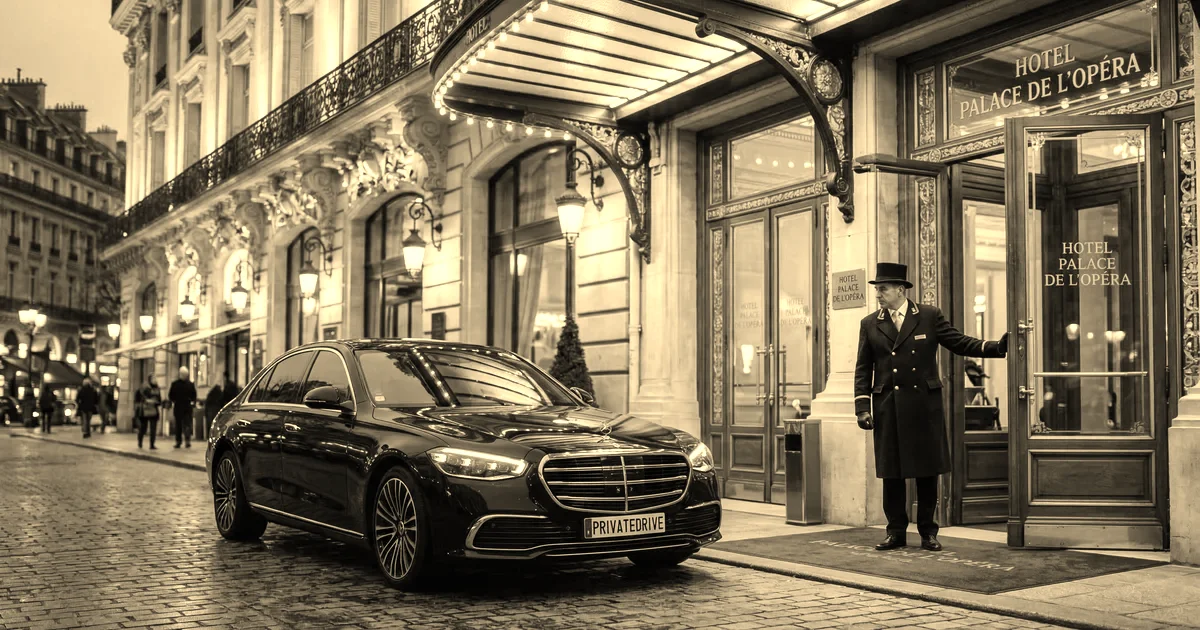
France did something no other country has done. In November 2010 it created the Distinction Palace, a state-recognised tier sitting above the five-star ceiling, awarded by the minister for tourism after review by an independent commission. The list, maintained by Atout France, holds 31 establishments, roughly ten of them in Paris, and it has barely moved since the six designations of October 2019. No other European jurisdiction has a legal grade above five stars. Yet the operational standard those 31 houses embody is not French. It is the working benchmark for every ultra-luxury hotel from Mayfair to Lake Geneva, and it shapes how a premium chauffeur operator wins, keeps or loses the most valuable accounts in the business.
For a transport operator, the palace tier is not a tourism curiosity. It is a procurement specification written in everything but the contract language. A hotel that has spent fifteen years and several million euros defending a state distinction does not hand its arriving guests to a driver whose car, suit or manner undercuts the lobby they just walked through. The partnership standard is implicit, it is exacting, and across Europe it is converging on a single grammar even where the legal label does not exist.
One French label, a pan-European benchmark
The Palace distinction codifies twelve qualitative criteria: incomparable location, legendary character, remarkable architecture, world-class dining, a multilingual concierge desk open around the clock, a responsible-operations policy. An applicant must already hold five stars for at least 24 months before the commission will even open a file. The October 2024 reform cut the validity period from five years to three, triggering a rolling cycle of renewals from 2025 onward. Six properties were re-confirmed in the first wave, including Mandarin Oriental Lutetia and Shangri-La Paris, and the full 2026 collection is unveiled in early June.
Outside France, the benchmark exists under different names. The Forbes Travel Guide is the closest structural equivalent. Its 2025 awards covered more than 2,100 properties across 90 countries and named 336 Five-Star hotels worldwide. The Forbes method matters to transport operators for one reason: service accounts for 70% of a property’s rating, facilities for the remaining 30%, scored against up to 900 objective criteria by incognito inspectors who check in as ordinary guests. A meaningful share of those criteria touch the arrival sequence, and the arrival sequence is the chauffeur.
Leading Hotels of the World, a membership collection of more than 400 independent properties, runs its quality control through Leading Quality Assurance (LQA), whose anonymous audits test the full guest journey. Many palace and Five-Star houses subscribe to LQA on top of their public rating, building an internal compliance loop that mystery-shops the doorstep, the transfer and the departure. When a chauffeur collects a guest at Charles de Gaulle or London City, that journey is, on any given week, potentially part of an audit the operator will never be told about. This is the structural reason the hotel concierge selection grid for transport partners is so much tighter than the rest of the market assumes.
The hubs: where the demand actually sits
The geography of ultra-luxury hotel demand in Europe is concentrated, and a chauffeur operator’s account strategy follows it precisely. Paris remains the densest single cluster, ten palace properties packed into the eighth arrondissement and its neighbours, from the avenue Montaigne to the place Vendôme. London’s equivalent sits in Mayfair: Claridge’s, The Connaught and The Berkeley under the Maybourne Hotel Group, the Savoy on the Strand, plus the Park-side houses on Hyde Park.
Milan has become the most dynamic of the secondary hubs. Citywide RevPAR rose roughly 5% in 2025 on strong international and event-driven demand, and the Quadrilatero della Moda now anchors a cluster of new and converted luxury houses serving the fashion and design calendars. Geneva and Monaco occupy a different niche: lower room counts, higher discretion, a clientele weighted toward private banking, family offices and principals who arrive by private jet. Geneva’s lakefront houses live off the cross-border flow from the airport and the financial district; Monaco runs on event peaks (the Grand Prix, the Yacht Show) that compress a year of premium transport demand into a handful of weeks.
The wealth behind this demand is structural, not cyclical. The global population of ultra-high-net-worth individuals passed 625,000, controlling some USD 30 trillion in assets, and Europe captured the fastest luxury-segment RevPAR growth of any region, up 7.9% through late 2024 against a 5.8% sector average. The Europe luxury hotel market is sized at roughly USD 30.4 billion in 2025, forecast above USD 33 billion in 2026. Suite-focused houses in London and Paris average well above EUR 1,000 a night. That guest does not book an app to leave the airport. The profile of the European premium traveller is exactly the profile a palace concierge is paid to protect from friction.
What a palace actually requires from a transport partner
Ask three palace concierges what they need from a chauffeur partner and the answers rhyme. The vehicle is the entry ticket, not the differentiator. A current-generation Mercedes S-Class, BMW 7-Series, or their electric equivalents (EQS, i7) in dark livery, immaculate, under three years old, is the floor. Maybourne publishes indicative chauffeur tariffs that read like a fleet specification in themselves: S-Class or 7-Series hire around £120 to £135 per hour with a two-hour minimum, a Mercedes V-Class for groups, bespoke daily rentals from £500. Those numbers tell an operator what the per-hour economics of a true palace account look like, and they are not the economics of the volume market.
The vehicle is roughly a third of the assessment. The rest is the chauffeur and the process around the chauffeur. The recurring requirements break down as follows.
| Requirement | What the palace expects | Why it is non-negotiable |
|---|---|---|
| Fleet standard | S-Class / 7-Series / EQS / i7, dark livery, <3 years, spotless interior | The car is an extension of the lobby; it is graded in Forbes and LQA audits |
| Chauffeur grooming & conduct | Dark suit, no fragrance, door protocol, silence unless addressed | First and last human contact of the stay; sets the service tone |
| Discretion | No name disclosure, no social media, NDA on principal movements | UHNWI and political clientele; a single leak ends the account |
| Service-level agreement | On-time guarantee, flight tracking, named backup driver, 24/7 dispatch | A missed CDG or LCY pickup is a failure the concierge owns, not the operator |
| Insurance & cover | Commercial passenger liability, high indemnity ceiling, certificate on file | The hotel’s own risk exposure when it recommends a third party |
| Local protocol fluency | Private-jet FBO access (Le Bourget, Farnborough), low-emission-zone compliance | The guest journey starts before the hotel and must be seamless |
The insurance line deserves emphasis, because it is the criterion operators most often underweight and concierges most often verify. When a palace recommends a transport partner, it accepts a sliver of reputational and legal exposure for a third party operating under its name. A concierge desk that has been through one uninsured-incident scare keeps certificates on file and asks for renewals. The specifics of professional liability cover for luxury chauffeurs are not back-office paperwork; they are part of the pitch, and an operator who can produce the right certificate before being asked has already separated itself from most of the field.
The arrival sequence, audited
Consider a single transfer to understand why the standard is so unforgiving. A principal lands at Le Bourget on a private jet at 09:40. The palace concierge has briefed the operator on the tail number, the FBO, the luggage count and the guest’s preference for no conversation. The chauffeur is plate-side, in a dark EQS, twenty minutes early, low-emission-zone compliant for the run into the eighth arrondissement, and has the cabin at the requested temperature. He opens the rear door, says nothing beyond a greeting, loads the luggage, and delivers the guest to a doorman who already knows the car. The entire sequence is invisible. That invisibility is the product.
Now invert it. The car is a clean but visibly older saloon, the driver is parked in the wrong zone and calls to ask where the guest is, the cabin smells of air freshener, and the run into Paris hits a low-emission-zone restriction the operator did not check. None of this is catastrophic on its own. Together it is exactly the friction the palace charges EUR 1,500 a night to eliminate, and the concierge who recommended that operator will not do so again. Forbes inspectors and LQA auditors score precisely this gap between the intended and the delivered arrival.
The same logic governs the dining and cultural journeys a palace orchestrates around a stay. Pre-booked transport tied to a three-star restaurant reservation or a private gallery viewing is part of the same chain, and it is where the gastronomy-driven transport demand across Europe meets the hotel account. A late table at a Michelin house, a waiting chauffeur, a discreet return: the operator who handles the whole evening without a single message to the concierge is the one who gets the next booking.
How operators actually win palace accounts
Palace and Five-Star accounts are not won on a rate card. They are won on the absence of incidents over a long observation period. The entry mechanism is almost always a trial: a concierge tests a new operator on low-stakes transfers, a staff airport run or a routine shopping circuit, before trusting it with a principal. The operator who treats the trial run as casually as a volume booking never advances. The operator who delivers the same standard on a EUR 90 staff transfer as on a EUR 1,500 day with a head of state moves up the concierge’s mental list.
The economics reward the patience. A palace account is a stream of pre-booked, high-unit-value journeys with predictable lead times, the structural opposite of the algorithmic, immediate-dispatch volume model. An operator running framework relationships with three or four palace houses in a single city holds a planned-work ratio that smooths utilisation and protects margin in a way no app-fed flow can. That stability is itself part of why these accounts sit at the heart of the widening split between luxury and mass-market transport across Europe. The two halves of the market are diverging on economics, not just on branding.
Standards also flow downward through the chain. The professional path from ride-hailing driver to premium chauffeur is, in practice, the path from no-standard to palace-standard. A driver who has absorbed the door protocol, the discretion rules, the grooming code and the route discipline of one palace account carries that template to every other premium booking. The hotel tier trains the segment whether or not it intends to.
Convergence, with national accents
The legal labels differ across Europe and will keep differing. France has its state distinction, Britain has no equivalent grade above five stars, Italy and Switzerland lean on Forbes, LHW and their own five-star classifications. The operational standard converges anyway, because the clientele is the same handful of hundreds of thousands of ultra-wealthy travellers moving between the same dozen cities, and because the audit regimes (Forbes, LQA) are international by design.
The national accents are real and an operator must read them. In Paris, low-emission-zone compliance and Le Bourget protocol fluency are baseline. In London, the Mayfair houses publish chauffeur tariffs that effectively set a public price floor and expect M25 and London City fluency. In Geneva and Monaco, cross-border movement, jet-arrival coordination and an almost total discretion override everything else. An operator who exports a Paris playbook unchanged to Geneva will misread the account.
For operators building cross-border European route capacity, PrivateDrive runs a fleet structured around exactly this hotel-account logic out of its Paris, CDG, Orly and Le Bourget operations, with the vehicle standard, discretion protocol and insurance posture that a palace concierge verifies before recommending a partner. The partnership standard, once a French peculiarity, is now the price of entry to the most valuable accounts on the continent.
The 31 properties on the Atout France register are the most qualified B2B prospect list a premium transport operator in France will ever read. Their equivalents in Mayfair, Milan, Geneva and Monaco extend that list across Europe. None of them advertises a transport tender. The operator who understands the standard, produces it without being asked, and never gives the concierge a reason to look elsewhere does not need them to.
Sources: Atout France, Distinction Palace register and 2024 reform (validity reduced from five to three years); Forbes Travel Guide, 2025 Star Awards (336 Five-Star properties, 90 countries, service 70% / facilities 30%, up to 900 criteria); Leading Hotels of the World and Leading Quality Assurance audit framework; Maybourne Hotel Group published chauffeur tariffs, Claridge’s and The Connaught; CBRE and Cushman & Wakefield European hotel performance data 2025 (London ADR £234.58 and RevPAR £207.93 July 2025, Milan RevPAR +5%); Mordor Intelligence, Europe Luxury Hotel Market 2025 to 2031; UHNWI population and asset data (625,000+ individuals, USD 30 trillion).
Tourism & Prestige
Palaces, starred gastronomy, high-end events: our B2B analysis of the prestige-tourism segment and what it demands from premium chauffeur operators across Europe.
Browse the observatory →