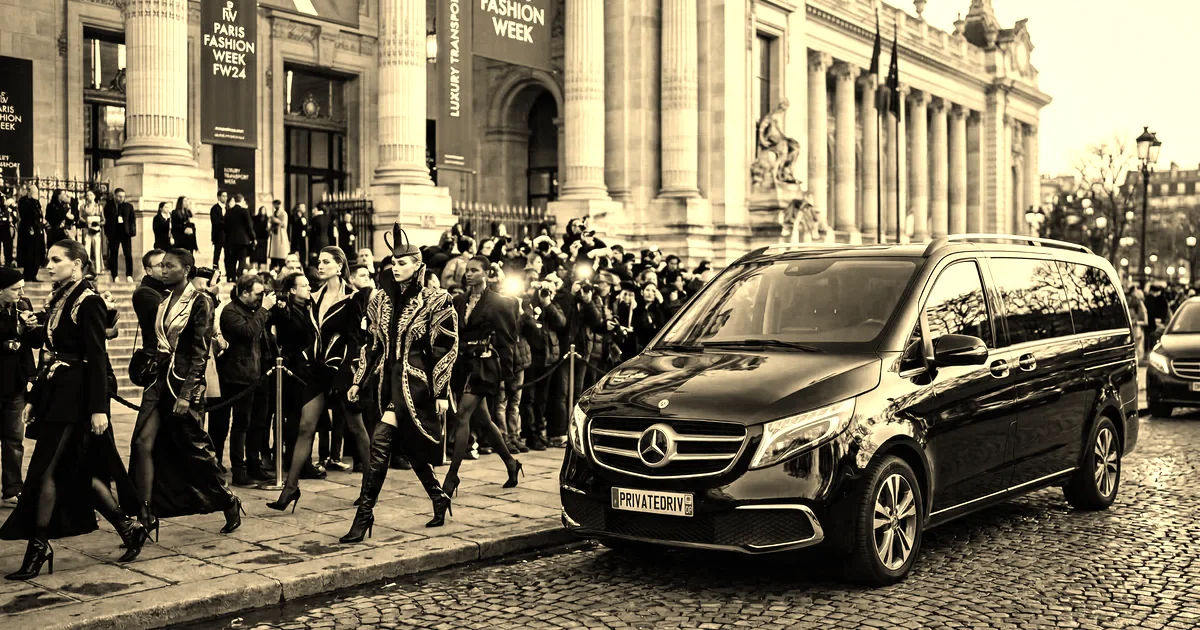
Three European capitals, one continuous logistical chain. The Big Four fashion circuit opens in New York, then crosses the Atlantic for the European leg that defines the season commercially: London, Milan, Paris, run back-to-back over roughly three weeks. The February-March 2026 womenswear calendar is precise on this point. London Fashion Week ran 19 to 23 February, Milan from 24 February to 2 March, and Paris from 2 to 10 March. The September-October cadence repeats the sequence for the following spring-summer collections, with London on 17 to 21 September and Milan from 23 to 29 September. For premium chauffeur operators across these three markets, the circuit is not three separate events. It is a single migrating demand wave that moves north to south and tests the operational depth of every fleet it touches.
The economic weight is concentrated in Paris but distributed across all three cities. The Federation de la Haute Couture et de la Mode places direct annual fallout from Paris fashion weeks at around 1.2 billion euros, with roughly 30,000 accredited professionals transiting the capital each cycle. Milan injected an estimated 239 million euros into its city economy during the September 2025 womenswear edition alone, up 12% year on year according to figures cited by city and industry sources. London Fashion Week contributes in the region of 269 million pounds to the UK economy each year, the British Fashion Council positioning it as the flagship of a fashion sector worth 32 billion pounds nationally. Below those headline numbers sits a transport layer that almost no fashion coverage measures, yet which determines whether the entire choreography holds together.
Why ground transport is the silent organ of the circuit
A fashion week is not a sporting fixture. No single venue polarises movement, and no fixed kickoff time governs the tempo. Buyers and editors string together ten to fifteen shows a day, from mid-morning into the house dinners that run past midnight. Between two shows the operational window narrows to five to fifteen minutes. A single mistimed transfer costs a front-row seat that an editor-in-chief will occupy three times that season. The chauffeur is not moving a passenger from A to B. The chauffeur is protecting a calendar that has zero slack built into it.
Each European city imposes its own geometry on this problem. Paris concentrates the heaviest shows on a venue triangle anchored by the Grand Palais on Avenue Winston Churchill in the 8th, the Carrousel du Louvre in the 1st, and the Palais de Tokyo on Avenue du President Wilson in the 16th. Milan compresses its activity into the Quadrilatero della Moda and the cluster around Via Montenapoleone, Via della Spiga and the Fondazione Prada in the south of the city, with venues rarely more than fifteen minutes apart in light traffic and forty minutes apart when the city saturates. London spreads across a wider footprint, from the British Fashion Council hub at 180 Strand to designer venues in Mayfair, Soho and the East End, which makes its show-to-show timing the least forgiving of the three despite a smaller volume of accredited attendees.
The constant across all three cities is that house addresses arrive late and confidentially, often a few hours before the show. This is precisely what separates grande remise operators from generalist platforms, as the split between prestige operators and volume aggregators across European markets has already shown. A driver who knows the fire-access lanes behind the Grand Palais, the loading dock rotation at the Carrousel, or the one-way reversals around Via Montenapoleone is worth more in those fifteen-minute windows than any algorithmic dispatch.
The logistics of the accredited thirty thousand
The 30,000 accredited professionals at the Paris cycle do not travel alone. Each mobilises a short but dense chain: an assistant, a press officer, a photographer. Transport demand swells by a factor of three to four against an ordinary Tuesday in March or October. The concentration is extreme. During Paris womenswear, the 8th and 16th arrondissements absorb two-thirds of premium movements, and the central venue triangle records peaks above a thousand chauffeured vehicle movements per day on cross-operator estimates. Milan replicates the pattern at smaller scale inside the Quadrilatero, where the density of luxury maisons within walking distance paradoxically raises chauffeur demand rather than lowering it, because the protocol value of arriving by car outranks the convenience of walking.
Passenger typology dictates vehicle format, and it is consistent across the three capitals. Editors-in-chief, creative directors and first-rank celebrities require an S-Class saloon or a high-end SUV with tinted glass, a precise drop point and a driver trained in discretion. Influencers and media teams arbitrate more on cost and flexibility, but they impose tight time windows for post-show content. House operational teams run V-Class vans or five-door people carriers to move models, equipment and dressers between backstage, atelier and the partner hotel. This typology maps directly onto the broader segmentation set out in the European premium traveller profile, where recurrence and protocol sensitivity, not price, define the highest-value accounts.
Captive house fleets and the contracts behind them
The major groups do not rely on the open market. LVMH, Kering and the large independent houses contract dedicated fleets months ahead of the official calendar, with a handful of selected operators in each city. The volumes are substantial. A major house mobilises between fifteen and thirty saloons over seven to ten consecutive days, which equates to 120 to 300 chauffeur-days across a single week in a single city. Contracts embed round-the-clock standby, English-speaking drivers, sign-then-destroy confidentiality rules, and a coordination protocol with press offices and partner event agencies.
For a premium operator, capturing one of these accounts is worth a full quadrant of the annual P&L. A comfortable fashion week represents two to three weeks of revenue compressed into seven days on the fashion portfolio. It is also a live stress test of organisational robustness. A failing dispatch chain, a driver lost in the one-way grid behind Rue Saint-Honore, or a saloon broken down on Avenue Montaigne: each incident exposes the operator on a market where the houses remember names and decide quickly. The same dynamic governs the relationship between operators and the luxury hotels that anchor each circuit, a selection logic examined in the palace hotel chauffeur partnership standard, where the house fleet and the hotel fleet often overlap on the same week.
Surge pricing and the scarcity of supply
The intensity of demand translates into a pricing tension that extends well beyond fashion itself. Luxury hotels run occupancy close to 94% on peak nights, with average daily rates above 520 euros in Paris and comparable spikes in Milan and London. A significant share of that hotel demand flows onto the European palace category, whose concierge desks become the de facto routing layer for VIP movements during the week, a function detailed in the analysis of how hotel concierges select premium transport partners.
On transport the adjustment is sharper still. Standard ride-hailing platforms apply algorithmic surcharges of 30 to 80% depending on time band and zone, particularly on end-of-show slots and the return from house dinners. Pre-booked premium vehicles become unobtainable in the open market by the second day. A parallel long-term rental market emerges, with chauffeured saloons offered from around 2,500 euros per week excluding fuel and overtime in Paris, and broadly similar reference points in Milan and London once currency and local cost bases are normalised. For receptive agencies orchestrating international arrivals across multiple cities, this inflation forces commitments in January or July, two to three months before the shows.
The circuit measured city by city
The table below sets the three European legs side by side against the variables that determine operator exposure: 2026 dates, scale of accredited attendance, economic impact, the dominant venue cluster, and the structural transport constraint specific to each city. The asymmetry across the rows is the operationally interesting line. Paris carries the volume, Milan carries the density, and London carries the dispersion.
| Variable | London | Milan | Paris |
|---|---|---|---|
| Feb-Mar 2026 dates | 19 to 23 Feb | 24 Feb to 2 Mar | 2 to 10 Mar |
| Sep 2026 dates | 17 to 21 Sep | 23 to 29 Sep | late Sep to early Oct |
| Economic impact (reference) | ~GBP 269m / year | ~EUR 239m (Sep 2025, +12%) | ~EUR 1.2bn / year |
| Dominant venue cluster | 180 Strand, Mayfair, East End | Quadrilatero della Moda | Grand Palais / Carrousel / Palais de Tokyo |
| Structural constraint | Dispersion, longest transfer legs | Density, kerbside saturation | Volume, ~1,000+ daily movements |
The back-to-back scheduling is what converts three city events into one logistical problem. The gap between London closing on 23 February and Milan opening on 24 February is a single day. Milan closes on 2 March, the same day Paris opens. Accredited buyers and press do not return home between legs. They move with the circuit, which means the demand wave migrates intact from one city to the next, carrying the same passengers, the same time pressure and the same protocol expectations. An operator working only one city sees a one-week spike. An operator or alliance covering two or three legs sees a three-week sustained surge that requires either a standing multi-city presence or a trusted partner handover at each border.
Multi-city sequential operations
Few independent operators run owned fleets in all three capitals. The dominant model is a sequential handover, where a Paris-based operator coordinates with a Milan counterpart and a London counterpart to maintain continuity of service for a single house or a single high-value client across the full circuit. The coordination object is not the vehicle, it is the passenger profile and the protocol. A house security team that vetted drivers in London expects the same standard in Milan and Paris without re-vetting from scratch, which places a premium on operators who can certify driver standards across borders.
This is where the fashion circuit converges with the wider doctrine of European event transport. The same operational muscles that absorb a Grand Prix weekend, a major tennis final or a film festival, surge fleet allocation, kerbside choreography and cross-border driver coordination, are the muscles the fashion circuit exercises three times over in three weeks. The doctrine established for major sporting events across Europe applies almost line for line to the fashion calendar, with one difference: the fashion circuit moves the venue while the sporting calendar moves the date. An operator who has built a repeatable event playbook treats the London-Milan-Paris sequence as three executions of the same plan rather than three improvisations.
Fleet allocation under this model is a pre-positioning exercise, not a reactive one. Saloons and vans are committed to house contracts weeks ahead, which strips them out of the spot market and intensifies the scarcity that drives the 30 to 80% surge. The operator who treats the fashion calendar as a capacity-planning problem, reserving lease lines and driver rotas in the preceding quarter, captures the high-margin captive accounts. The operator who waits for inbound requests in February is left bidding for the residual spot demand at peak cost with no protocol relationship to defend the margin.
Venue-specific constraints that drivers must internalise
Each Paris site imposes distinct rules. The Grand Palais operates on regulated convoys, with VIP drop zones separated from press access and tight coordination with house security. Accredited drivers receive a daily pass and a sequencing order on the approach avenue. The Carrousel du Louvre grants basement access to a predefined vehicle list during slots negotiated with the museum administration, and Rue de Rivoli becomes impassable from late morning on major show days. The Palais de Tokyo offers relatively fluid access outside flagship shows, but the Quai de New York saturates during evening runway slots, with Trocadero tourist flows compounding the congestion.
Milan and London impose parallel disciplines. Inside the Quadrilatero, kerbside space is the binding constraint: the density of venues within a few hundred metres means drop and collection points are rationed by the minute, and drivers who fail to read the rotation cause cascading delays for every fleet behind them. In London, the dispersion between 180 Strand, Mayfair and the East End means a single afternoon can require two motorway-grade transfer legs across central congestion charging zones, which rewards drivers who pre-plan routing around the Ultra Low Emission Zone and the timed access restrictions of the West End.
What the circuit reveals about European premium transport
The fashion circuit functions as a revealer. It does not create a parallel market, it measures the real capacity of operators to hold a premium specification under sustained pressure across three cities in three weeks. The structures that exit each cycle with a consolidated portfolio are those that fielded a dedicated dispatch, a coherent fleet, drivers trained on protocol, and a discipline of dematerialised communication. The rest slip down the implicit ranking the houses keep current from season to season.
The 2026-2027 calendar prolongs the sequence without pause. The September womenswear leg follows the same north-to-south migration, and the menswear and couture weeks add further compressed windows earlier in the year. At each cycle the same question recurs across all three capitals. How many saloons can be mobilised within three hours, on which time band, and with what carbon documentation? The answer is not built in season. It is anticipated by the quarter, in framework contracts whose relational drafting matters as much as the rate card. For operators structuring cross-border European routes, PrivateDrive integrates Paris, CDG, Orly and Le Bourget operations into the same event-grade dispatch logic the fashion circuit demands. The fashion calendar does not invent the boundary between the premium artisan and the algorithmic aggregator. It renders it, three weeks per season, perfectly legible across London, Milan and Paris at once.
Sources: Federation de la Haute Couture et de la Mode, Paris fashion week impact figures; British Fashion Council, London Fashion Week economic contribution; Camera Nazionale della Moda Italiana and Milan city economic estimates, September 2025; Fashion Week Online, Big Four economic boost analysis; Fashionista and modemonline.com, 2026 fashion week calendars; premium chauffeur operator service data for Paris, Milan and London fashion weeks, 2025-2026 seasons.
Tourism & Prestige
Fashion weeks, palace hotels, starred gastronomy, corporate travel: Grande Remise documents the European premium travel ecosystem and its interaction with grande remise operators.
Browse the observatory →